
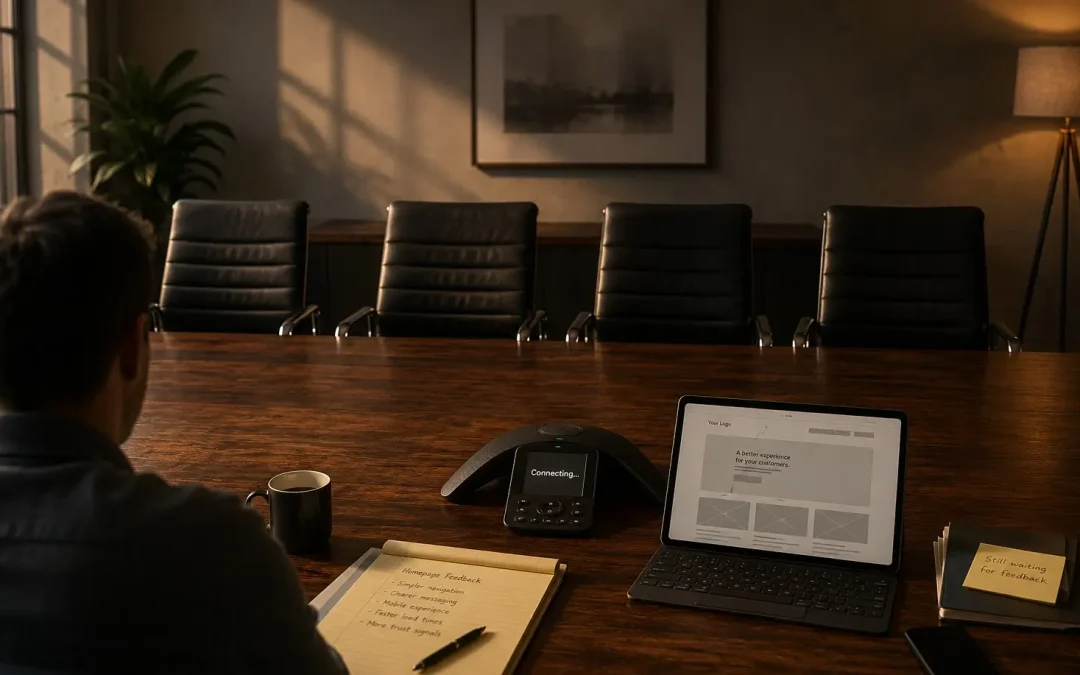
Post Summary: Five Skills, and Almost Nobody Has All Five
The work asks for five things at once: selling, designing, developing, serving, and listening. Very few people carry all five, so the usual answer is to divide them among several people. Each split has a cost. Visual talent without attention produces something handsome that misses the client entirely. Attention without technical ability produces a brief that degrades on the way to code. Sales ability without follow-through produces a signature and then silence.
A homepage once went out in blue after the owner had asked for light green. She disliked the result, and the color itself was not the reason. Her preference had been stated and then overridden.
Below is how the economics of this work make that outcome ordinary, and what gets built when listening comes first.
It Is Not Who You Picked, It Is the Incentives
It’s not one thing. That’s what makes it so frustrating. It’s not that web designers are all scammers. It’s not that the technology is too complicated. It’s not that you picked the wrong company and it’s not because you’re asking how much small business website costs, but might not be sure what else to ask.
It’s that the entire system is built on a set of incentives that have almost nothing to do with building you a good website.
Why is it so hard to find a good web designer? Because the industry rewards speed over depth, volume over quality, and closing the deal over serving the client. Because the skills required to do this job well are so stacked and so interdependent that almost no one has all of them, and the companies that could develop those people have no financial reason to try. Because the culture at large, not just in web design but everywhere, has become a waiting-to-speak culture instead of a listen, digest, and respond culture. And when your entire business depends on someone understanding what you need and translating it into something real, that gap is where everything breaks.
The Skill Stack Nobody Talks About
Here’s what a good web designer needs to be able to do. Not a decent one. A good one.
They need to sell, not in a pushy way, but in a way that builds trust, reads people, and earns the conversation. They need to design, understand layout, color theory, visual hierarchy, what draws the eye and what loses it. They need to develop, write code, structure headings for search engines, build pages that load fast and work on every device. They need to serve, follow up, follow through, remember the details, return the call, manage the relationship after the sale is done and be damn great at serving you and your website the best support after launch.
And they need to listen. Not hear, listen. The kind of listening where a client says “I like light green” and you remember it. Because if you build a blue website because you thought blue was better for their industry, you’ve already lost. Put two identical websites side by side, one with a blue hero image and one with light green, and the client will hate the blue one. Not because blue is wrong. Because you weren’t in tune enough to honor what they told you. You decided you knew better than the person whose business you’re supposed to represent.
That’s not a design failure. That’s a listening failure. And it happens every day at companies where the person building the site never had the conversation with the client in the first place.
Now stack all of those skills on top of each other, sales, design, development, customer service, listening, and then add the infrastructure. Contact management systems where notes are detailed enough for someone to understand a client’s business at a glance. Task automation that tells you when to reach out, when a deadline is approaching, when an edit request has been sitting too long. Scheduling discipline. Quality assurance. Creative problem-solving for businesses you’ve never worked in before.
It’s not one skill. It’s not two or three. It’s a suite, and every piece depends on every other piece. A brilliant designer who can’t listen builds beautiful websites that don’t represent the client. A great listener who can’t code hands off a vision that gets lost in translation. A strong salesperson who can’t serve disappears after the contract is signed. You need all of it, stacked, in the same person or the same tightly-run team. And finding that is extraordinarily hard. Which is exactly why most companies don’t even try, and why the gap between what you need and what you get from a professional web design company can feel so wide.
The Incentives Underneath All of It
Seven posts in this series have covered specific ways this goes wrong. Templates sold as custom work. Proposals that run long without saying much. Designers who disappear because the role was sales all along. Account managers standing between you and the person building your site. Companies spread across seven verticals and deep in none. Sites that look like every other site in the category. Platforms your website cannot leave.
Those are the symptoms. Here’s the disease.
Incentives in this business tend to point at one thing: volume in, and staying in. The sales rep gets paid to close. The executives get paid when volume goes up. The contract is what keeps the arrangement in place after the fact. Everything in the model is optimized for acquisition and retention, not for quality, not for communication, not for the thing you hired them to do.
We don’t think everyone at these companies are greedy. Most of the people working inside them are trying to do a good job. They have bills. They took a position because they believed the pitch. But the structure they’re working inside doesn’t reward doing right by the client, it rewards hitting the number. And when the structure and the intention are misaligned, the structure wins every time.
This gets taught plainly. Stephen Roe, co-founder of the web design platform Sitejet, put it plainly in a sales guide published in Smashing Magazine:
“When you reach the end of a call with a potential client, your job is simple, get them to pay for your web design services.”
— Stephen Roe, Co-Founder, Sitejet. Source: smashingmagazine.com
That’s why the problems we’ve been writing about aren’t isolated incidents. They’re features. The template exists because it’s fast and cheap. The account manager exists because the skill stack is too expensive to find in one person. The proprietary platform exists because lock-in is more profitable than earning your business every month. Each one is a logical outcome of an incentive structure that values the company’s efficiency over the client’s experience.
The First Ninety Seconds With a Burned Client
You can tell in the first ninety seconds. The answers are short. The energy is flat. They’re not rude, they’re guarded. They’ve sat through this pitch before. They’ve heard the promises. They’ve been told “we’re different” before.
When a business owner sits down with us after being burned by two or three web designers, we don’t open with our portfolio. We don’t show them our reviews. We don’t launch into a presentation about our process. We start with something closer to this:
“Sounds like you’ve had a tough go at this whole website thing.”
And then we shut up. Because they have to open up in order for us to do our job. If they stay guarded, we can’t learn their business. If we can’t learn their business, we can’t build them anything worth having. So we ask questions, not from a script, not from a form with twenty fields, but questions that come up naturally because we’ve done this hundreds of times and we know what matters.
And somewhere in that conversation, something shifts. They test us with a detail. We catch it. They mention something about their process and we ask a follow-up question nobody has ever asked them before. And slowly, carefully, the guard drops. Not because we earned their trust, we haven’t yet. But because we said something honest: “I know I haven’t earned your trust. But if by the next meeting I do a great job, do you think I could start to?”
Then we launch on time. Maybe early. Because they’ve been screwed so many times that doing something considerate, delivering ahead of schedule, not because we have to but because we want to, matters more than any sales pitch we could give.
And at the end, we ask the question most companies never think to ask: “How did we do? Was this experience different than what you’ve had before? Do you feel more comfortable?”
That’s not a sales technique. That’s a relationship. And it’s remarkable that in an industry built on relationships, almost nobody bothers to build one.
Every Industry Is Getting Worse, Web Design Just Makes It Personal
This isn’t only a web design problem. Go to a restaurant chain and count how many servers seem glad you’re there. Go to a big box store and try to find someone who knows their product line. Call a customer service number and see how many transfers it takes to reach a human who can help.
The culture of service, genuine, attentive, give-a-damn service, is declining across the board. And in every single industry, at every single company, you’ll find someone great. One person who cares, who listens, who treats you like you matter. The problem is that finding them is a lottery. You call in, you get the phone queue, and you pray you land on the person who’s going to take care of you instead of the one who’s watching the clock.
Web design makes this worse because the stakes are personal. This isn’t a delayed shipping notification or a cold burger. This is your business. Your name. The thing you’ve spent years building, and you’re handing it to someone you found on Google and hoping they treat it with the same care you do. When they don’t, when the site comes back looking like everything else, when the person who sold it stops answering, when you can’t even talk to the human making decisions about your digital presence, it feels like a betrayal. Because it is one.
Two Products, No Contract, No Account Manager
We didn’t start this company because we thought the web design industry was evil. We started it because we saw an inefficiency. A gap between what small business owners need and what the industry was giving them. A market where the pricing didn’t match the value. A market where the relationships disappeared after launch. A market where the smallest businesses, the local ones without a marketing department, had the fewest good options.
So we built a company that fills that gap. Two products. $130 a month or $4,000 to own. No contract. No proprietary platform. No account manager standing between you and the person building your site. No template rotation. No six-page proposal full of jargon designed to make you feel small.
We built it around the principle that clients, we call them clients, not customers, because the word matters, should be treated the way we want to be treated. That’s it. That’s the whole Yeetish philosophy, not complicated, but client focused. No mission statement written by a committee. Just: do what you said you’d do, explain it in words people understand, and care about the outcome as much as the person paying for it.
We’re strict about this. We have systems, contact management, task automation, scheduling, quality assurance, because systems are what keep the standard from slipping when things get busy. But systems without culture are just software. The culture is the part that matters. The listening. The follow-through. The willingness to launch early just because someone’s been through hell and deserves something nice.
What Hiring a Web Designer Should Feel Like
Here’s the version of this industry we’re working toward. Not the one that exists, the one that should.
One where a business owner can search for a web designer, find someone competent, and not have to wonder if they’re about to get scammed. One where the proposal is clear, the pricing is honest, and the person you talk to is the person who builds your site. One where your website is yours, built on a platform you can take with you, designed around your business instead of a template, and supported by someone who knows your name a year after launch.
One where finding a good web designer isn’t hard. Where it’s the norm, not the exception. Where the bar isn’t “they called me back”, it’s “they listened, they understood, and they built something I’m proud of.”
That industry doesn’t exist yet. But every client we serve, every website we build, every time someone says “this is how it should have been all along”, it gets a little closer.
And if you’re reading this after being burned once, twice, three times, we get it. We’ve heard the stories. We’ve seen the damage. We’ve sat across from the skepticism and worked through it one project at a time. We’re not asking you to trust us. We’re asking for one conversation. If you’ve been through it before and want to know how to vet a web design company before signing anything, that’s a smart place to start.
That’s always been enough.
Frequently Asked Questions
Why is it so hard to find a good web designer?
Because the job requires a rare combination of sales ability, design skill, technical development knowledge, customer service discipline, and deep listening, all stacked on top of each other and supported by strong internal systems. Most companies split these skills across multiple people to make hiring easier, which creates the communication gaps, turnover, and quality issues that business owners keep running into.
Is the web design industry getting better or worse?
The tools are getting better. The service, broadly, is not. Customer service standards are declining across most industries, and web design is no exception. At every company there are people who care deeply about their work, the challenge is that landing on them is increasingly a matter of luck rather than industry standard.
How do I avoid getting burned by another web design company?
Ask three questions before you sign anything. What happens to my website if I leave? Will I talk directly to the person building my site? And what does communication look like a year from now, not during the sales process, but after the honeymoon period? The answers will tell you whether the company is built around serving you or retaining you.
What is working with Yeet Websites like?
We focused on two things, web design and SEO, instead of spreading across seven verticals. The person you talk to is the person who builds your site. We don’t use contracts, proprietary platforms, or templates. And our pricing is transparent: $130 a month or $4,000 to own, both built on standard open-source software, both fully custom. The model is designed so that we earn your business every month rather than locking you in.
What should I expect from the first conversation with Yeet?
Expect questions, about your business, your process, what makes you different, what’s worked and what hasn’t. Expect the person on the call to be the person building your site. And expect honesty, if your current website is fine and you don’t need a rebuild, we’ll tell you that, even if it means losing the sale. The conversation is where the real work starts, and it’s designed to make sure anything we build sounds like you, not like a template.