
Post Summary: The Answer to What You Own Is Already Fixed by the Time You Ask
Most business owners find out what they own on the day they try to leave, and by then the arrangement is already settled, so the protection is knowing now which one you’re in.
Four things are in play and each behaves differently: the domain, the code, the login, and the content.
The domain belongs to the business no matter whose account it sits in. A web company holding it is the administrative contact, not the owner, and ICANN policy requires registrars to honor a transfer request from the legitimate owner.
The code depends on what you paid for. A one-time project fee delivers a finished site you can host anywhere and hand to most developers. A monthly fee for the website itself is a lease rather than a purchase, and the code stays with the company. Both are legitimate arrangements.
The login follows the code. Owning it means backend access makes sense. On a subscription there’s little reason to need one, and needing to log in to get basic changes made points at service rather than access.
Content splits. Your story, your process, your photos of your own work are yours. Copy written for you, graphics designed for you, and photography sourced on your behalf sit in a gray area, and the time to settle that is in the agreement at the start rather than on the way out.
Ownership is available as a $4,000 custom WordPress build. WordPress is open-source, so the files run on standard hosting and most developers can work with them.
Checking takes minutes. A monthly fee for the site itself means subscription. A one-time fee with only hosting after means you likely own the code. A registrar lookup shows who holds the domain.
Switching Providers, Something Breaking, a Relationship Going Sour
At some point, when you’re switching providers, when something breaks, when a relationship goes sour, you’re going to need to know what you own. Most business owners don’t find out until that moment. And some of them discover the answer is less than they assumed.
The question of website ownership is more nuanced than it sounds. It’s not a simple yes or no. It depends on how your site was built, what you’ve been paying for, and what your agreement says. Here’s how to think through each piece.
The full list of what you should own, and what’s negotiable
There are four things in play when we talk about website ownership: the domain, the code, the login, and the content. Each one operates differently.
The domain is yours. Full stop. Your domain, bobsplumbing.com, whatever it is, belongs to your business regardless of where it’s currently registered. A web company can be the custodian of your domain, holding it in their account for administrative convenience, and that’s fine as long as the relationship is working. But the moment you need it transferred, you get it. Nobody holds domains hostage. There’s no business incentive to try, and any company that attempted it would have a very short remaining lifespan. The domain is yours.
The code is where it gets conditional. If you paid for an ownership build, a one-time project cost that delivers a finished site you take with you, you own the code. It’s yours to host wherever you want, hand to most developers, or modify however you see fit. If you’re on a subscription model, paying monthly for a site that’s built and maintained by the company, you don’t own the code. That’s not a scam. That’s the model. The subscription is a lease, not a purchase. You’re paying for access to a service, not for the underlying asset. Both models are legitimate. The important thing is knowing which one you’re in.
The login follows from the code. If you own the code, having backend access makes sense, it’s your site, you should be able to get in. If you’re on a subscription, there’s functionally no reason for you to have a login. The company should be handling everything. If you find yourself needing to log in to get basic changes made, that’s not a login problem, that’s a customer service problem. If that sounds familiar, the post on paying for a website service but doing the work yourself digs into what that dynamic really means.
The content is yours, mostly. Anything you brought to the project, anything that came from your business, your story, your process descriptions, your service areas, your photos of your actual work, that’s your intellectual property. Where it gets complicated is content the web company created on your behalf: the copywriting they wrote, the graphics they designed, the photography they sourced or produced. That content lives in a gray area, and it’s a tightrope worth walking carefully when you switch providers. Be transparent with your new company about what was created for you versus what you created. Don’t hand them someone else’s copyrighted material and ask them to build on top of it.
What happens when you try to leave and discover you don’t own it
This conversation happens, and it usually goes one of two ways depending on why the client is leaving.
If the site wasn’t working, if they’re leaving because the service was bad, the results weren’t there, or the relationship broke down, the code question almost doesn’t matter. They needed something new anyway. The old site wasn’t delivering. What they need from the departure is the domain transferred cleanly and whatever content is clearly theirs. Then they start fresh, and the fresh start is the point.
If the site was working and they’re leaving for other reasons, a better price, a referral, a company that closed, losing the code is a real loss. It means rebuilding something that was functioning. That’s a legitimate cost of the subscription model, and it’s one of the real arguments for ownership if you have a site that’s performing well and you want the security of knowing you can take it anywhere.
What never happens, or should never happen, is someone leaving and losing their domain or their core business content. Those belong to the business. Any company that tried to retain them would be making a very expensive legal mistake.
Why most web companies don’t even offer ownership
It’s worth understanding how rare the ownership model is in this industry. Most web companies don’t offer it at all. The subscription model is the default because it creates recurring revenue, which is how most service businesses sustain themselves. Build once, collect monthly, it’s a rational business structure.
The companies that do offer ownership tend to be smaller, more specialized firms where the economics work differently. At Yeet Websites, ownership is a real option, $4,000 for a custom-built site on WordPress, which is open-source code that most developers can work with. You take it with you. It runs on whatever hosting you want. Nobody has a lock on it.
The other way we end up with ownership-model sites is through inheritance, clients who come to us after their previous developer retired, moved on, or unfortunately became unable to work. Those are usually referral situations. The developer built something solid, life changed, and now the client needs someone to take over. That’s one of the better arguments for building on open-source platforms: even if the person who built your site is gone, the site doesn’t disappear with them.
How to check right now what you own
The fastest test is this: are you paying a monthly fee specifically for your website, not for SEO, not for marketing, but for the website itself?
If yes, you’re on a subscription model. You don’t own the code. That’s not a crisis, it’s just the reality of the arrangement you’re in. You own the domain. You own the content you created. You have a relationship with a company that’s responsible for maintaining and hosting your site as long as you keep paying.
If you paid a one-time project fee and you’re now paying only for hosting, or nothing at all, you likely own the code. Log into your hosting account. If it’s there, it’s yours.
The domain is the easy check: go to a registrar lookup tool and search your domain. It will show you who the registrant is. If it’s your company name or your name, you’re confirmed. If it’s your web company’s name, that’s fine as long as the relationship is in good standing, just make sure you have a clear path to transfer it if you ever need to.
The content question requires some honest accounting on your part. Go through the site and ask: did I write this, or did they? Did I provide these photos, or did they source them? The material that came from your business is yours. The material they created belongs to them until you have a specific agreement otherwise. Know the difference before you take anything with you.
These ownership gaps are one of the structural problems that quietly set businesses up for trouble down the road, the kind of thing covered in our post on why business websites fail.
Frequently asked questions
If my domain is registered in my web company’s account, can they refuse to transfer it?
No. Domain ownership is governed by ICANN policy, and registrars are required to honor transfer requests from the legitimate owner of the domain. Your web company holding the domain in their account doesn’t give them legal title to it, it makes them the administrative contact, not the owner. If a company ever tried to hold your domain hostage, they would be in serious legal and regulatory trouble. It essentially never happens. If you’re concerned, the safest move is to register and manage your own domain independently from the start.
What’s the real difference between owning my site and being on a subscription?
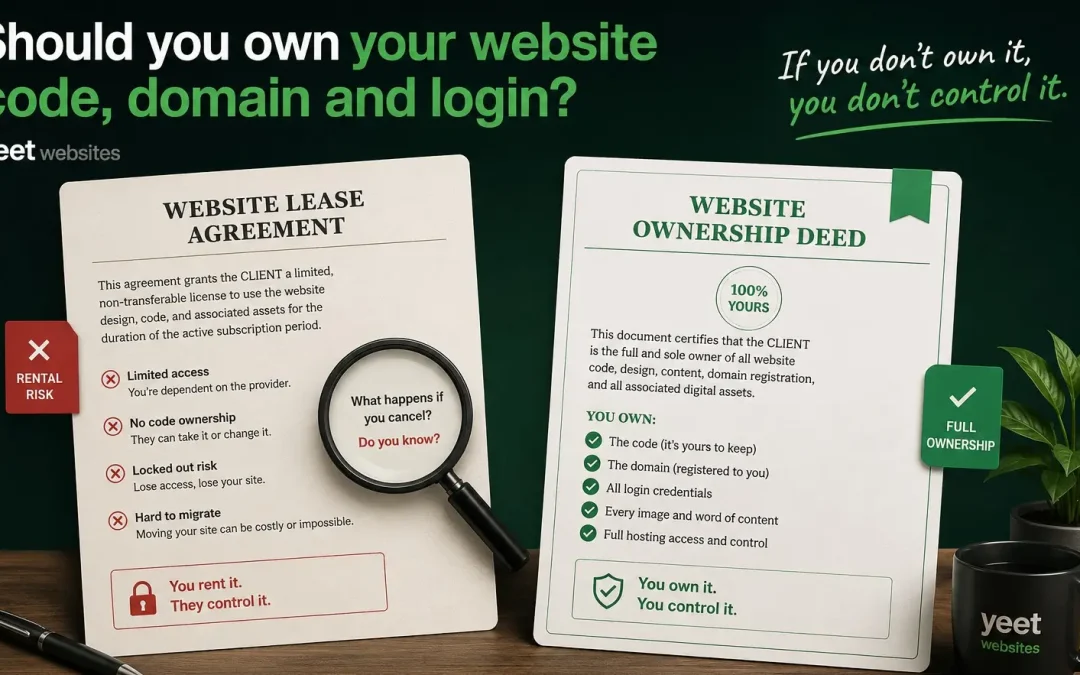
Ownership means you have the underlying code, files you can take to most hosts or most developers and continue using. Subscription means you’re paying for access to a service that includes a site built and maintained by the company. If you stop paying on a subscription, you lose access to the site but you keep your domain and your content. If you own the code and stop paying for hosting, the site goes offline but the files are still yours. Think of it like renting vs. owning a building, the subscription is the lease, ownership is the deed.
What happens to my subscription site if the web company closes?
This is the real risk of the subscription model and it’s worth thinking about honestly. If the company closes, your site goes with it. Your domain survives, you’d get that transferred, but the site itself would need to be rebuilt. This is one of the stronger arguments for the ownership model if continuity is a priority. It’s also an argument for building on widely-supported open-source platforms rather than proprietary systems, since at minimum you’d have something a new developer could reconstruct from.
Can I negotiate content ownership when I sign up with a web company?
Yes, and it’s worth doing. If you want explicit rights to the copy, graphics, and other assets created on your behalf, put it in the agreement upfront. Most smaller firms will accommodate a reasonable content ownership clause. The time to have that conversation is before the project starts, not when you’re trying to leave. Once the work is done and the relationship is ending, the leverage is mostly gone.
Is WordPress really the safest platform for ownership purposes?
It’s among the best options for portability, yes. WordPress is open-source software that runs on standard hosting infrastructure. Most qualified developers can work with it. The files are transferable. There’s no platform lock-in, no proprietary format that only one company can read or maintain. That’s why we build on it. When you own a WordPress site, you genuinely own something, not just a license to use a closed system that disappears if the company behind it changes direction.