
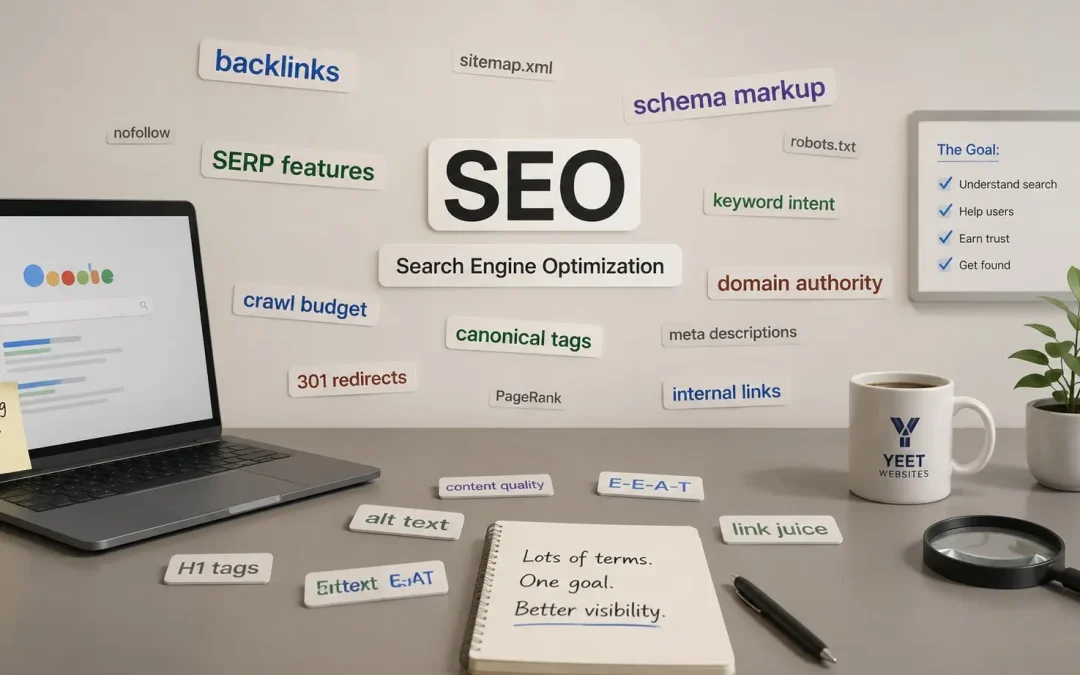
Post Summary: A SEO Report that’s Difficult to Read Can’t Be Questioned
A report you can’t read leaves you no way to ask whether the work is working. That’s the cost of untranslated vocabulary, and it lands on the person paying rather than the person writing.
Some of the terms sound harder than the ideas behind them. The skyscraper technique is finding content that’s already doing well, building something better, and emailing the people who linked to the original. Topical authority is writing a lot of good material about one subject until search engines recognize you know it. Entity salience is how prominent and relevant a concept is inside your content.
The terms describe real things. The problem starts when someone leads with the vocabulary instead of the explanation, because then the report arrives on time, looks busy, and settles nothing.
A readable report puts the plain sentence under the number. Unique visitors up from last month. Bounce rate down, which means more people are staying. Fourteen booking form submissions. Not what the metric is called, what it means for the business.
If a proposal has five terms you don’t recognize, ask. Asking tells you nothing by itself, since most providers are glad to explain. What tells you something is what happens next: if you walk away more frustrated instead of less, that’s the answer.
The Email You Close and Come Back To Later
The SEO company sends you a report. It’s got charts, percentages, terms you’ve never seen before. Backlinks. Domain authority. Crawl budget. You read it twice, maybe three times, and you still can’t tell whether you’re winning or losing. So you do what most business owners do. You close the email, tell yourself you’ll look at it later, and go back to running your business.
That’s not a failure on your part. That’s a failure on theirs.
The language the SEO industry uses wasn’t designed for you. Some of it is habit, learned in forums from people who learned it the same way and never had to explain it to anyone outside the room. Whatever the reason, the outcome is the same: you’re spending money on something you don’t understand, and you don’t have the vocabulary to push back.
When nobody translates the language, it becomes a tool, and when it’s used deliberately, it starts to look a lot like an SEO scam dressed in technical vocabulary. That’s the line this post is here to help you see.
They’re Talking Over You, Not to You
When an SEO company starts throwing around terms like backlinks, domain authority, and crawl budget without breaking each one down so it’s easily digestible, they’re just talking over at the client. And in that case, they’re treating you like a customer, not a client. That’s an important distinction.
A customer gets a transaction. A client gets a relationship. Transactions don’t require understanding, just a credit card and a signature. Relationships require that the person across the table knows what they’re paying for, why it matters, and what it’s doing for their business. When your SEO company can’t get out of their own technical vocabulary long enough to have that conversation, they’ve already told you which one you are to them.
Now, is the jargon intentional? Sometimes. It can work. It does allow you to sort of trample on people, and if that’s how your mode of operation is, then we’re sorry for you and those that you encounter. But most likely, they just don’t know how to talk to a person.
That’s the part people miss. This isn’t always malice. This is people talking to people and not knowing how to do that in a fair way. They learned SEO from other SEO people. They speak in acronyms and frameworks because that’s the room they’ve been in for years. And somewhere along the way, they forgot, or never learned, that the business owner sitting across from them didn’t grow up in that room.
The result is the same either way. You leave the call confused, and you don’t have the words to challenge what you just heard.
SEO Jargon That Means Less Than You Think
There are terms the SEO industry throws around that sound like they belong in a graduate program. They don’t. Here are three that get used constantly to make the work sound more exclusive than it is.
Skyscraper Technique. This one sounds so super glamorous. What it means: you find a piece of content that’s already doing well and do a bigger, better version of it. That’s it. Make something better and email a bunch of people. Like, give me a break. The concept is fine, study what’s ranking, build something more thorough, reach out to people who linked to the original. But calling it the Skyscraper Technique turns a basic content strategy into something that sounds like it requires a permit.
Topical Authority. This is probably the biggest offender. People just throw it around like it’s some sort of measurable metric when really it’s just write a lot of good stuff about a subject. You cover a topic thoroughly, you publish consistently, and over time search engines recognize that you know what you’re talking about. That’s it. But it sounds better when someone says I have insane Topical Authority, it definitely imparts a very exclusive voice when you say something like that. It shouldn’t.
Entity Salience. Give me a break. It means how prominent and contextually relevant a concept is within the content. Google has said for years that contextual relevance matters, that what you write should be in the same voice and context of everything else on your site. That’s the idea. But this phrase makes a normal business owner’s eyes glaze over in about two seconds. And it’s supposed to.
None of these terms are wrong. They describe real concepts. But when someone leads with the vocabulary instead of the explanation, they’re not teaching you, they’re performing for you. There’s a difference.
The Report That Tells You Nothing
Ask a business owner who’s had SEO done for them to pull up their last monthly report. Chances are it’s full of charts they didn’t build, metrics they can’t define, and a summary that reads like it was written for a different audience.
And here’s how that becomes a weapon. Unless you’re going to somehow remember the unfamiliar term, write it down, look it up, and then go back and say hey, what do you mean?, how are you going to be able to push back? You can’t challenge what you can’t name. And if you can’t push back, the provider never has to prove anything. The report exists. It looks busy. It arrived on time. That’s enough to keep most people paying for another month.
It’s almost like witch magic or some sort of wizardry. The information might all be there, and it might even be accurate, but if you can’t read it, it doesn’t matter. A report you can’t understand is a report that protects the provider, not the client.
The jargon is part of the engine of a bad SEO company. Not because every company using technical language is bad, but because a company that never translates it has no incentive to. As long as you’re overwhelmed, you won’t ask the one question that matters: is this working?
What a Report Should Look Like
When we build reports, we make them so you don’t need a glossary to read them. We’ll do a screenshot of the previous month, or a before-and-after comparison, and then write in plain English exactly what it’s telling us. Not what the data says. What it means.
Here’s what that looks like in practice:
Standouts this month:
Unique visitors: 1,842 (up from 1,340 last month)
Google organic visits: 1,108
Visitors are spending over two and a half minutes on your site, viewing over two pages per visit, that’s real engagement.
Bounce rate: 38% (people leaving too quickly), down from 46%, which means more people are sticking around.
Top-performing pages: Services, About, Contact
Booking form submissions: 14
That’s it. You read the words. You go back and look at the charts. And it all clicks and makes sense.
The difference isn’t the data, most providers have access to the same analytics platforms. The difference is who’s willing to sit down and tell you what the data means in a sentence you’d say out loud. We write it that way because we think if you’re paying for something, you should understand what it is you’re paying for.
How to Read an SEO Proposal You Don’t Understand
If you’re looking at an SEO proposal right now and there are five terms you don’t recognize, just ask. That’s the move. Don’t assume someone’s trying to rip you off. Don’t assume they’re incompetent. Just ask: what are these things? I’ve never heard of this.
Asking tells you nothing about the company by itself. Most providers are glad to walk you through everything, because they believe in what they’re doing and they want you to understand it.
The red flag isn’t the jargon. The red flag is what happens when you ask about it.
If they can’t explain it in a way that makes sense, if you’re getting more frustrated, not less, if you walk away from that conversation still wondering why am I paying for this if I don’t understand it, that’s a different story. That’s not a communication breakdown. That’s a company that either can’t or won’t meet you where you are.
Don’t just assume that someone’s out to get you. Give them the chance to make it right. Have them explain their process. But if you get all the facts and it’s very clear that things aren’t the way they should be, then now’s the time to start looking. Not in a panic, just with your eyes open. Look at how other providers communicate. Look at whether they can explain what you’re paying for and solve the problems you’re trying to solve.
The Vocabulary Isn’t the Problem, the Translation Is
SEO has real terminology. Backlinks are real. Crawl budget affects how search engines interact with your site. Domain authority is worth translating carefully, because it’s one company’s estimate of how likely a site is to rank, not something Google publishes or uses. That’s the kind of thing you should be told the first time you see it in a report.
The problem is when the vocabulary becomes a wall instead of a window. When the terms exist to keep you on the outside instead of bringing you in. When the complexity of the language becomes the reason you can’t evaluate whether the work is any good.
We use technical terms when we need to, and then we explain them. In parentheses. In plain sentences. On screen shares where you can see what we’re pointing at. The goal is never for you to become an SEO expert. The goal is for you to read a report, understand what’s happening, and feel confident that your money is going somewhere real.
If your current provider can’t give you that, it’s worth a conversation. And if you’re not sure what to ask, start with the simplest version: can you explain this to me like I’m not in your industry?
If they can, you’re probably in good hands. If they can’t, or won’t, you’ve got your answer.
Frequently Asked Questions About SEO Jargon
Why do SEO companies use so much jargon in the first place?
Most of the time it’s not a strategy, it’s a habit. SEO professionals learn the craft from other SEO professionals, and after years of talking in acronyms and frameworks, they forget that the person paying the bill didn’t grow up in that room. The ones who translate are the ones who care whether you understand what you’re buying.
What should I do if I don’t understand something in my SEO report?
Ask. Don’t assume someone’s out to get you. Say “I don’t know what this means, can you walk me through it?” Most providers are glad to. If they can’t explain it in a way that makes sense to you, that tells you something about how the rest of the relationship is going to go.
Is there a difference between jargon and legitimate SEO terminology?
Yes, and the line is translation. Terms like backlinks, indexing, and site speed describe real things that affect your rankings. The problem isn’t the vocabulary. It’s when someone uses it without explaining it, so you can’t tell whether the work is helping or not. A good provider uses the terms and then tells you what they mean in plain English.
How does Yeet Websites handle SEO reporting differently?
We write everything in plain English. Screenshots of the data, then sentences underneath explaining what it means, not what the metric is called, but what it’s telling us about your business. Things like “visitors are spending over two and a half minutes on your site, that’s real engagement” instead of a chart with no context. You should be able to read the report and know whether things are working without needing a glossary.
Can jargon be a sign of an SEO scam?
It can be, but it’s not automatic. Jargon becomes a weapon when a provider uses it to avoid accountability, when the language is complex enough that you can’t push back, and the reports are dense enough that you can’t tell whether anything is working. If you ask for clarity and get more jargon, that’s the red flag. The language isn’t the scam, the refusal to translate it is.