
Post Summary: Four Things to Check When SEO Isn’t Moving
Four things tell you what an SEO spend has been buying: the site structure, the keyphrases, the links, and whether the traffic was ever organic. All four are checkable, and none of them require taking a provider’s word for it.
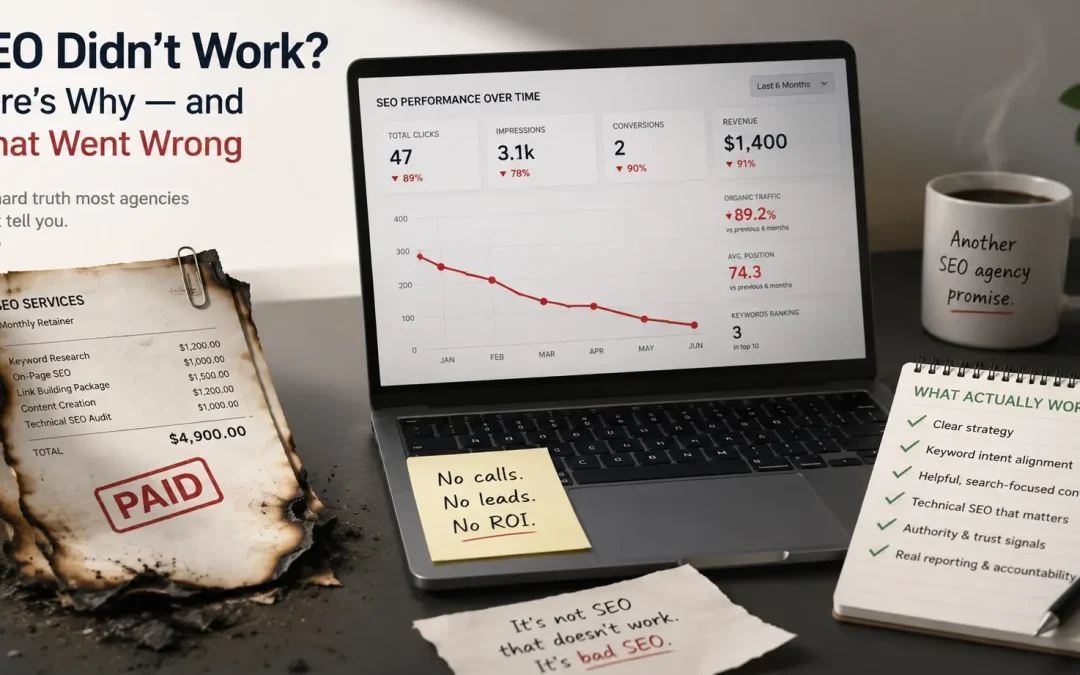
A roofing contractor was paying almost a thousand a month for SEO and close to three thousand for ads. The dashboard was green and traffic looked strong. Then the ads got turned off and traffic fell off a cliff. Every visitor had been coming from the paid side. Organic was zero, and the SEO money had been buying spammy networks and links that don’t rank anything.
That’s the test when both are running at once. Pause the ads for two weeks. If the traffic disappears, the SEO was never working.
Three things get checked first. Site structure, because SEO layered on a broken foundation holds nothing. Keyphrases, because terms that sound right in a conference room instead of what people type produce rankings without customers. And links, pulled up one by one to see whether they’re niche-relevant or just volume.
The timeline question has no fixed answer. A clean site with solid structure and no bad links can show movement in a couple of months. A site that needs cleanup first can take longer than six, and nobody knows which until they open the walls. It’s the house flip problem: the sagging floor and the rafters rotted by an old roof leak aren’t in the listing photos.
Before canceling, ask for the links and ask to see them. Ask about schema, structure, duplicate content, page speed. A polished report instead of a direct answer tells you what you need to know.
Four Thousand a Month and a Green Dashboard
He was paying almost four thousand dollars a month. A grand for SEO, almost three grand for ads. And the reports looked great, traffic was up, clicks were up, everything the dashboard could show him said things were working. Then we turned off the ads.
Traffic fell off a cliff.
That’s when it became clear. The SEO spend, a thousand dollars a month, every month, had been buying spammy networks and terrible links. The kind that don’t rank anything, and that in a deliberate pattern like this one can put a site at real risk. The traffic he thought was organic was coming entirely from paid ads. He had no organic whatsoever.
He didn’t come to us saying “I think I got scammed.” He came to us saying his SEO didn’t work. And that’s how most of these conversations start, not with suspicion, but with confusion. You paid, you waited, and nothing happened. Or worse, something looked like it was happening and then the floor dropped out.
What We Look at First When SEO Didn’t Work
When someone comes to us and says they paid for SEO and nothing happened, we don’t start with their content calendar or their keyword list. We start with three things.
First, site structure. That’s the web development side. If the foundation of the site is broken, messy code, poor hierarchy, pages that don’t communicate with each other the way search engines need them to, then nothing built on top of it will hold. SEO layered on a broken site is like painting a house with a cracked foundation. You can make it look good from the curb, but the structural problems are still there.
Second, keyphrases. We check whether the phrases they’re trying to rank for are in line with what they do. You’d be surprised how often a business is targeting phrases that sound right in a conference room but have nothing to do with how real people search. If the keyphrases don’t match the business, the traffic won’t either, even if the rankings improve.
Third, links. We pull up every backlink pointing to the site and check for toxic ones. If someone paid for SEO and the links aren’t niche-relevant, that’s usually the first red flag. If the links are niche-relevant and from real sites, they should have helped. When they didn’t, the problem is usually upstream, structure or content.
Three Things We Find When We Open a Site Up
Three things account for most of what we find when we open a site up, and the first two have nothing to do with the business owner.
One is the DIY version. A business hires a marketing person with no search experience, and that person is doing blogs and posts and hunting for backlinks. Even SEO professionals get it wrong. Someone learning on the job with your money and your rankings almost never pays off.
On the provider side, the most common failure is PBN networks, private blog networks. These are spammy link farms designed to trick Google into thinking your site has authority. They worked years ago. Google is onto all of it now. PBN links sold in 2026 don’t work, whatever the reason they’re still being sold.
And here’s the thing that makes this industry dangerous: if you don’t know the right question to ask, this is an industry where you will get screwed and taken advantage of, because the playbook produces a professional-looking report and no organic movement, month after month. That’s not cynicism. That’s pattern recognition from years of cleaning up other people’s messes.
What the Disavow Was For
What came after the ads went off is the part worth understanding. The SEO line item on that invoice had been producing nothing except a number on a report. Most of the time that’s the whole story: bought links don’t count, and the money buys nothing. His case went further, because the links weren’t just irrelevant, they came from networks built to manipulate rankings, and a deliberate pattern like that is one of the few things Google still acts on directly rather than quietly ignoring.
So we’re building it back up, and disavowing some of the links, which means formally telling Google to ignore them. Most sites never need that step. This one did.
That’s a common trick, and it’s worth understanding why it works. If you’re running ads and SEO at the same time and the provider sends you a combined traffic report, you can’t tell where the results are coming from unless you know what to look for. The ads produce clicks. The SEO produces nothing. But the report says “traffic is up” and the client assumes both are working.
If you’re paying for SEO alongside ads, here’s the test: what happens to your traffic if you pause the ads for two weeks? If the answer is “it disappears,” your SEO didn’t work. It was never working.
How Long SEO Takes, and Why “Six Months” Isn’t the Real Answer
The biggest lie the industry tells small business owners is that SEO takes six months. Not because six months is wrong, sometimes it does. The lie is in presenting it as a fixed number, like a timer you start and wait out.
It depends on where you’re starting from. If there are major problems to fix, six months can go just to cleanup before a rebuild starts gaining traction. How many pages need recreating and reindexing? How deep is the damage?
It might be longer than six months.
If you have an absolutely perfect website, clean code, solid structure, no toxic links, no duplicate content, it can happen really quickly. A couple of months and you start to see noticeable improvement. But almost nobody walks in with a perfect site. That’s not why people come to us.
It’s like when you go buy a home you want to flip. You don’t know what’s going on in that home until you open up the walls and see just how bad the damage is. Then you see rafters completely damaged because of an old roof leak that they patched up with some asphalt roof patch. Whole floor sags. None of that was in the listing photos. None of it was visible from the outside.
Same thing with a website. Once you dig in and see what’s going on, the broken structure, the bad links, the thin content, the duplicate pages, that’s when you know exactly what you’re dealing with and how long it’s going to take. Anyone who quotes you a timeline before they’ve opened the walls is guessing. Or selling.
What to Ask Your SEO Provider Before You Pull the Plug
If you’re three months into an SEO engagement and seeing zero movement, don’t cancel yet. Ask questions first. Specific ones.
Start with the links. Ask them: what kind of links are you building for me? And then say: let me see them.
Are they on dating websites and you sell boat docks? Are they on high-traffic sites with nothing to do with your industry? Is it a niche-relevant backlink, a link from a site that’s related to what you do, or is it just some backlink? Because backlinks are not created equal. Less is definitely more. You want specific links to what you’re doing, not just a whole bunch of links to say that you did a whole bunch of links and you paid all this money for a bunch of links. That does not help.
Then look at the technical side. Ask about schema, that’s the back end code you can’t see that tells Google exactly what your page is about. If they’re not doing it, or if it’s auto-generated by a plugin and never checked, that’s a gap. Ask about site structure. Ask about duplicate content. Ask about page speed.
If the answers are vague, or if the response is another polished report instead of a direct conversation, that tells you something.
Or take it to someone who’ll open it up in front of you. We’ll look at the website, the links, the schema, the structure, all of it. All of it together gives a full picture of where the problem is, which is the part you need before anyone can fix anything.
If you’re not sure whether your SEO provider is the problem or the strategy is the problem, there are specific warning signs that point to the company itself, and they’re worth knowing before you sign with anyone else.
SEO Didn’t Work, or SEO Was Never Done
Spammy links aren’t SEO. A monthly report with bar charts isn’t SEO. Ranking for keyphrases nobody searches isn’t SEO. The word gets used as a blanket for whatever the provider wants to sell, and the business owner, who hired someone specifically because they don’t know this stuff, has no way to verify what’s real and what’s theater.
That’s not the business owner’s fault. But it is their problem. And the only way to solve it is to get someone who knows what they’re looking at to open up the walls and tell you what’s going on in there.
That’s where the real work starts.
FAQ
How do I know if my SEO provider is doing real work?
Ask to see your backlinks. If they’re from sites that have nothing to do with your industry, or from networks that exist only to sell links, the work isn’t real. Niche-relevant links from legitimate sites in your industry are what move the needle. If your provider can’t show you those, the money isn’t going where they say it is.
Can bad SEO hurt my site worse than no SEO at all?
Usually not, because Google’s systems neutralize most spam links rather than penalizing the site they point at, which means the money bought nothing and the rankings never moved. The exception is a deliberate pattern, a provider who built links through networks on purpose, which can draw a manual action from Google. That’s when disavowing is the right call, and it’s rarer than link-audit tools suggest.
What’s a realistic timeline for SEO to show results?
If the site is clean and the foundation is solid, a couple of months. If we’re fixing structural problems, bad links, and thin content first, it could be six months before the cleanup clears and the real build gains traction. Anyone who gives you a fixed number before looking at your site is guessing.
How much should I be paying for SEO that works?
Our SEO starts at $750 a month. That gets you niche-relevant backlinks, technical audits, content strategy, and schema markup, the things that produce real organic movement. Relevant links take time to find and earn, and that time is most of what the price covers.
What’s the difference between paid traffic and organic traffic?
Paid traffic comes from ads, Google Ads, social ads, display campaigns. When you stop paying, it stops. Organic traffic comes from search rankings that you’ve earned through content, structure, and links. When someone tells you their SEO is working but all the traffic disappears when the ads pause, the SEO was never working. The ads were doing everything.