
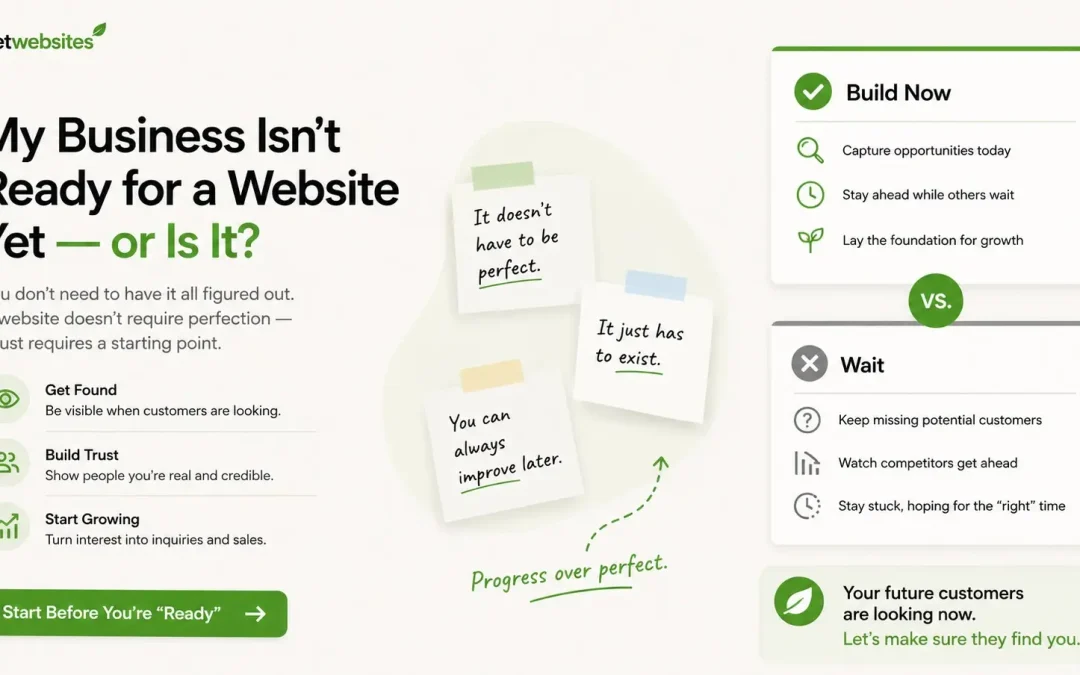
Post Summary: Web Designers Shape Your Rough Copy, That’s Part of the Build
An executive assistant at a plumbing company called about a website, and her opening position was that nothing could begin until all the copy was written and signed off. Her owner wanted perfection, and she was carrying that expectation for him.
Here’s what changed her mind. A document full of approved sentences still has to survive a layout, and words that read fine in a file can fall apart on a page. Rebuilding around them later costs more than starting with something rough. So the question got smaller: use what exists, add the rest along the way.
It took a while to land. Once she saw how small her side of it was, the pressure came off and the whole thing stopped feeling like something she would be graded on. She had been ready before she called.
Not everyone who says they aren’t ready is behind on anything. Sometimes the writing is done, the budget is set, and the only thing outstanding is the decision itself. Worth asking about plainly rather than guessing.
She Wanted Every Word Approved First
The executive assistant at a medium-sized plumbing company called us about a website. Not the owner, the assistant. And the first thing out of her mouth was that she needed to get everything together first. Everything meant everything. Every single bit of copy. Every page. Every word nailed down and approved before we could start.
You could feel the tension. This was someone under pressure from an owner who wanted it right, wanted it perfect, and had put the weight of that on her shoulders.
What She Thought She Had to Hand Over
We went back and forth. I told her she didn’t have to give me all of that. Oh no, it has to be right. It has to be this. I tried again. Explained that just writing out a list doesn’t mean it’ll look good online, formatting matters, layout matters, and if she hands me something that doesn’t work visually and I build the entire site around it, we’re going to have to change it anyway.
No, what do you mean?
That’s the moment. Two people in the same conversation, looking at the same project, one of them holding a standard nobody had asked her to meet. She’s a doer, head down, get it done, and that’s exactly why she’d taken the whole thing on herself.
So I asked her: can I use what I need, and then we can always add to it? Because that’s better. Give me what you have. Let me shape it. If something’s missing, we’ll handle it. You don’t need to hand me a finished product before I can start building one.
It took a few passes. But it ended up working out perfect.
And you could tell it was a relief. Once she realized how little she really needed to bring to the table, that the job wasn’t on her to deliver a perfect packet before the project could begin, the tension broke. Piece by piece, the project turned back into a project instead of a performance review. Her business was not ready for a website the way she defined ready. But by any definition that matters, she’d been ready longer than she realized.
When “I’m Not Ready” Is a Different Question
Sometimes someone tells you they’re not ready and you can hear that they are. They’ve got the copy. They’ve got the money. Nothing is missing except the yes.
When that happens, I don’t pitch. I ask.
Based on what I’m seeing, you’ve got great website copy. You said you have the money. So what would make this feel ready? Is there something you’d want to know about us first? Or is it the time, whether you can make the one or two meetings to sign off? Tell me which and we’ll work with it.
And then from there, have the conversation. Because “I’m not ready” is sometimes true. And sometimes ready is closer than it sounds. The way you find out is to ask what ready means to them and listen to the answer.
That assistant at the plumbing company was ready. She was over-prepared for a process that didn’t require it. The business was ready the day she picked up the phone. She just didn’t know it yet. And the moment someone told her that, not as a pitch, but as the truth, she could finally let go of the packet she thought she needed and start the thing she’d been putting off.
Yeetish Question
What if I don’t have all my website content ready before I contact a web design company?
You don’t need all of it. You probably don’t even need most of it. Give us what you have and let us shape it, that’s part of the job. What you have right now is enough to begin.