
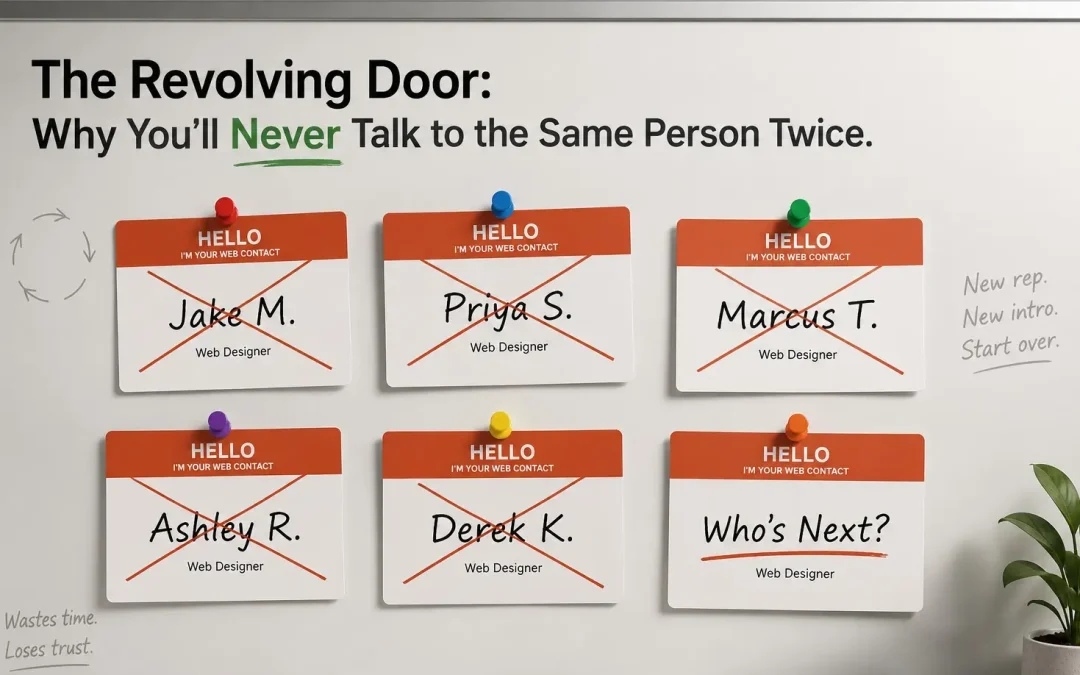
Post Summary: The Reset Costs You, Not the Company That Caused It
Roughly one in five of the business owners who come to us describe the same thing: they found out their web designer left by accident, because a name they’d never seen replied to an email or a different voice answered the phone.
In most of those accounts the person who left wasn’t a web designer at all. They were a sales rep, the one who sold the website and answered the calls. The heading tags, the backend architecture that determines whether the site performs, none of that was their skill set.
The model burns through them. Quotas, monthly targets, leaderboards, and the energy it takes to sell something you’re starting to have doubts about has a shelf life. The account gets reassigned and the cycle starts over.
What leaves with them is the institutional memory, and none of it was written down anywhere the next person can pull up. The new person opens the account and sees a name, a URL, and maybe a one-line note. So you re-explain your business, your goals, and the edit you requested, to someone learning forty other accounts at the same time.
Some companies remove the human instead. A login, a queue, a ticket number, a chatbot. That eliminates the most expensive problem a company has, which is people, and it deletes the relationship rather than maintaining it.
One question tells you more than any portfolio: what’s your turnover like? Watch whether they answer directly or redirect.
How Business Owners Find Out
Nobody told you. That’s the part that sticks.
You found out because you reached out about a change to your website and a name you’ve never seen before replied. Or you called the number you’ve always called and a different voice answered, someone who didn’t know your business, didn’t know your name, and didn’t know about the conversation you had four months ago about updating your services page.
My web designer left the company. You didn’t find that out from the company. You found that out by accident.
Roughly one in five of the business owners who come to us describe some version of this. Everything below is what they told us when they arrived.
It Wasn’t a Web Designer Who Left, It Was a Sales Rep
The person who left, in most of the accounts we hear, wasn’t a web designer. They were a sales rep.
They were the person who sold the website. Charming, responsive, available. They answered calls and made the project feel like it mattered. And because they were the main point of contact, the assumption was that they were the one building the site. Maybe they were, in the sense that they dragged and dropped content into a template and hit publish. But the heading tags that tell Google what your pages are about, the backend architecture that determines whether your site performs, that wasn’t their skill set. They were hired to sell, and building the website was a byproduct of closing the deal.
So when they leave, two things happen at once. You lose the only person at the company who knew anything about your project. And the technical problems left behind are now someone else’s, belonging to someone who has never talked to you and has forty other accounts sitting in the same queue.
It’s not just that their web designer left. It’s that the person who left was never really a web designer, and the website they left behind shows it.
The Business Model That Builds the Revolving Door
From what we’ve been told, this doesn’t happen because companies hire bad people. It happens because the model burns through them. Quotas, monthly targets, leaderboards, the kind of structure where you’re only as valuable as last month’s numbers. The energy it takes to sell something you’re starting to have doubts about has a shelf life.
Most of these reps start out believing it. Then they see the inner workings, that the custom website is a template with swapped colors, that the ongoing support they promised in the sales call is a ticket system and a queue rather than a person who picks up the phone. When that gap gets wide enough, they leave. The account gets reassigned, and the cycle starts over with someone who hasn’t figured it out yet.
What Walks Out the Door With Them
The website stays the same. The hosting keeps running. The pages don’t disappear. That’s what makes this hard to see until it’s too late.
What leaves is the institutional memory. The person who knew why you chose that hero image. The person who remembered you saying you didn’t want to sound corporate, you wanted it to sound like you. The person who knew you added a service six months ago and the site still doesn’t reflect it.
None of that was written down anywhere the next person can pull up. The clients who tell us this story describe the same thing every time: a great conversation about their business, the kind that should have been documented in detail, and no sign it was ever recorded. The new person pulls up the account and sees a name, a URL, and maybe a one-line note.
So you’re re-explaining everything. Your business, your goals, the edit you requested, the thing that was supposed to be done already. And you’re doing it with someone who’s learning forty other accounts at the same time, and who may not be there in twelve months either.
That’s not a handoff. That’s a reset. And you’re the one absorbing the cost of it every time.
The Self-Service Trap
Some companies solve the turnover problem by removing the human. They hand you a login and say you can make changes yourself, or they point you to a queue, a ticket number, a chatbot that asks you to describe your issue in 500 characters or less.
On paper it sounds reasonable. In practice, you just became your own web designer. You’re paying for a service and doing part of the work yourself. That’s like hiring a painter and being told you can touch up the trim whenever you want, as if that’s a perk and not a failure to finish the job.
This model exists because it eliminates the most expensive problem a company has, which is people. If nobody has to manage your account, know your name, or pick up the phone, there’s nothing to replace when someone leaves. The relationship gets deleted rather than maintained.
And you’re left at your computer at 10pm trying to change a phone number on your contact page, because the person who used to handle it doesn’t work there anymore and nobody replaced them. It’s the same reason you can’t talk to your web designer at most companies: the model was never built around access.
What to Ask Before You Hire Anyone
One question will tell you more than any portfolio or testimonial. Ask them: what’s your turnover like?
Ask the person on the phone, the one selling you, whether they’ll still be there in a year. Watch how they respond. Do they answer directly or redirect? Do they talk about how the work gets handed off, or do they dodge? If they hesitate, you have your answer.
And if they tell you turnover doesn’t matter because they have a customer service department or a self-service portal, that’s worth thinking about. It means the relationship is designed to survive a personnel change by not depending on a relationship in the first place.
The person who works on your website should know your business and why decisions were made, and should be someone you can reach directly rather than through a queue with a 48-hour response window. That’s what support after launch is supposed to mean.
Frequently Asked Questions
How do I know if my web designer was a sales rep or a real developer?
Ask them a technical question about your site. What’s the heading structure? How is the sitemap configured? What’s the page speed score and what’s affecting it? If they can’t answer without checking with someone else, or if they redirect you to a technical team, the person you’ve been working with was a sales contact rather than the person building your site.
What should I do if my web designer just left and I’m stuck with the company?
Request a meeting with your new point of contact immediately. Don’t wait for them to reach out, they may not know they have your account yet. Ask what they know about your project. If the answer is not much, that tells you how the company manages transitions. From there, decide whether to invest the time re-educating them or look at other options.
How does Yeet Websites handle it when someone leaves?
The person who builds your site is the person who answers when you call. There’s no account manager in between and no handoff to arrange, so there’s nobody to lose track of your history.