
Post Summary: Hospitals Evaluate Courier Websites Like a Vendor Audit, Not a Pitch
Business here is won or lost on whether the proof is visible and checkable. HIPAA, OSHA and DOT certifications, chain-of-custody documentation, temperature specifics, current insurance and bonding figures, all of it near the top of the page rather than in a footer or behind a download form. There is a second requirement that trips up most sites: two audiences with nothing in common. Procurement officers working through a checklist, and patients who are anxious and want plain sentences. A single page aimed at both tends to lose both.
One test sorts every badge and claim on such a site. Could a procurement officer confirm it alone, without calling anyone? That takes certificate numbers, issue dates, a route back to whoever issued it. Anything failing that is decoration.
Below: building separate routes for facilities and for patients, stating HIPAA compliance without exposing anything protected, and turning chain-of-custody documentation into an argument rather than a checkbox.
Three Couriers, the Same Fleet, Only One Gets the Call
A hospital procurement team is evaluating three medical courier companies for a specimen transport contract. All three have the fleet. All three serve the geography. All three quoted competitive rates. The evaluation moves to the websites, because the procurement team needs to verify compliance documentation, review chain-of-custody processes, and confirm insurance and bonding before they can advance any vendor past the initial screening.
The first site looks professional. Clean layout, modern design. But the compliance certifications are in the footer, small logos, no verification links. The chain-of-custody section is a single paragraph that says “we maintain proper handling procedures.” The insurance documentation isn’t on the site at all. The procurement officer notes “incomplete, request documentation” and moves on.
The second site has the certifications, but they’re scattered across three different pages. The chain-of-custody process is described in a downloadable PDF that requires an email address to access. The insurance information references a policy number from two years ago. The procurement officer notes “disorganized, verify currency” and moves on.
The third site puts compliance badges directly below the hero image on the homepage, HIPAA compliant, OSHA trained, DOT certified, with verification links to the issuing authorities. The chain-of-custody section walks through the process from pickup scan to delivery confirmation with a visual workflow diagram. Insurance and bonding numbers are current and verifiable. Temperature monitoring capabilities are described with specifics, not generalities. The procurement officer schedules a call.
That’s the gap that medical courier website design either closes or creates. The fleet, the rates, and the service area got all three companies to the evaluation. The website determined which one advanced. In medical logistics, hospitals won’t risk their license on “trust me.” They’ll risk it on proof, and proof has to be on the site, visible, verifiable, and current.
The Non-Negotiable Trust Signals
Medical courier websites have a definitive set of trust signals that must be on the site, not as design enhancements, but as requirements that determine whether a healthcare facility will engage with your company at all.
Compliance certifications come first. HIPAA compliance, OSHA training certifications, DOT authorization, state-level transport permits, every certification your operation holds needs to be visible on the homepage and accessible from every service page. Not in the footer. Not on a dedicated compliance page three clicks deep. Below the hero image, right below the fold, right when a visitor first scrolls on the homepage. That positioning communicates priority: you lead with compliance because compliance is the first thing your clients evaluate.
Each certification needs to be verifiable. A HIPAA badge without a link to verification is a design element, not a trust signal. A DOT number without context about what it authorizes is decoration. The certifications should link to issuing authorities or, at minimum, reference specific certification numbers that a procurement team can independently verify. Healthcare facilities audit vendors. Making verification easy accelerates the evaluation. Making it difficult raises the question of whether the certification is current, or real.
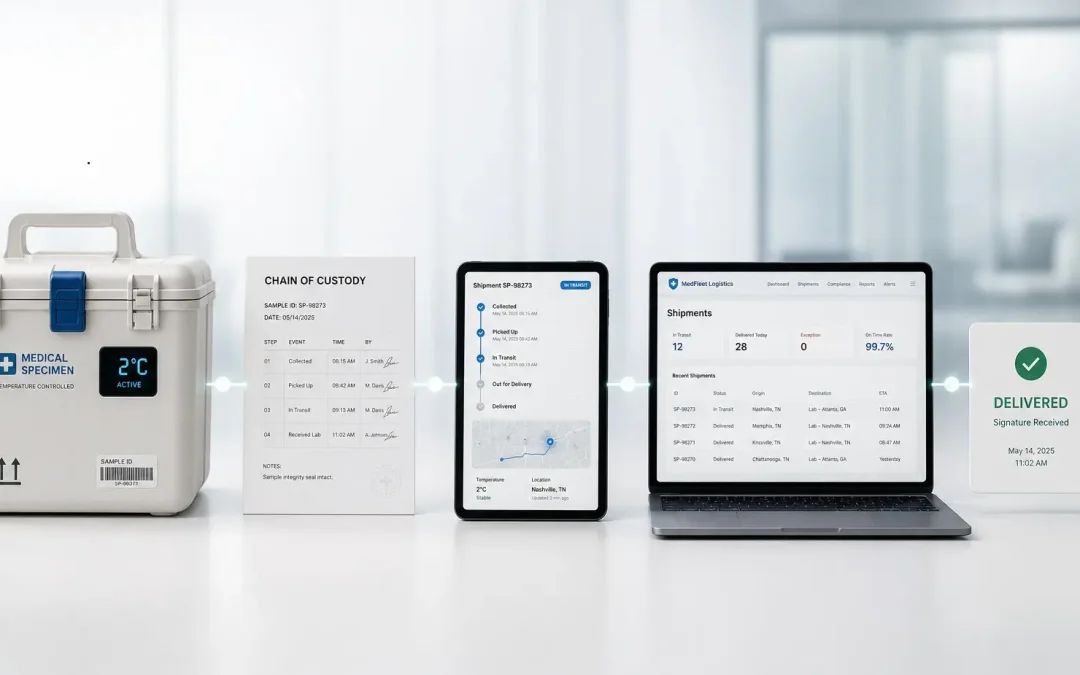
Chain-of-custody documentation is the second non-negotiable. Lab directors won’t call without seeing it. The process needs to be described on the site with enough specificity that a compliance officer can evaluate it: who handles the specimen at pickup, how it’s logged into the tracking system, what documentation accompanies it during transit, who receives it at the destination, and how each handoff is verified. A single paragraph saying “we maintain chain-of-custody protocols” fails this test. A visual workflow showing each step passes it.
Temperature-controlled transport proof needs to be front and center, not buried in a PDF, not summarized in a bullet point, not hidden behind a download gate. The site should describe the monitoring system, the temperature ranges maintained, and how the data is made available to clients. A facility evaluating cold-chain capabilities needs to see this information during their website review, not discover it during a sales call three weeks later.
Insurance and bonding numbers round out the non-negotiables. Hospitals and labs require proof of insurance and bonding before they can approve a courier as a vendor. The policy numbers, coverage amounts, and bonding status should be on the site, current, specific, and positioned where a procurement team expects to find them. “We are fully insured and bonded” without numbers is the “trust me” approach, and healthcare facilities don’t operate on trust. They operate on documentation.
Everything that your operation has earned, every certification, every compliance achievement, every insurance policy, needs to be on the site. The art is in making all of that happen on a custom build where the information is organized, accessible, and professionally presented. With a template, it’s going to look templated, and a healthcare procurement team can tell the difference.
Designing for Healthcare Facilities Versus Patients
Medical courier websites serve two fundamentally different user types, and the site architecture needs to separate them cleanly.
Healthcare facilities, the lab directors, pharmacy managers, procurement officers, and compliance teams who control the contracts, evaluate your site like they evaluate any vendor. They want compliance documentation, volume proof, chain-of-custody details, performance metrics, and a clear path to a quote. Their reading level is high. Their tolerance for marketing language is low. They’ve seen hundreds of vendor sites and they know what substantive content looks like versus what filler looks like.
Patients, the people receiving medication deliveries, checking specimen pickup schedules, or confirming delivery status, want something completely different. “How do I get my prescription delivered?” Simple, calm, no jargon. Their reading level varies widely. Their comfort with medical terminology varies widely. Their primary emotion isn’t evaluation, it’s anxiety. They want to know their medication will arrive safely, their information is protected, and they can reach a human if something goes wrong.
One page trying to convert both audiences converts neither. A facility procurement officer who sees “your medications delivered with care” as the homepage headline assumes the site is patient-facing and doesn’t serve their needs. A patient who sees “OSHA-compliant specimen transport with real-time chain-of-custody monitoring” assumes the site is for hospitals and leaves.
At this level, many operations already have a provider portal with different login buttons for user segmentation, facilities access compliance documentation and delivery logs through one portal, while patients access delivery scheduling and refill tracking through another. If your operation has this infrastructure, the website should mirror it: clear separation from the homepage, with distinct pathways for each audience type.
If the portal infrastructure doesn’t exist yet, the site still needs the separation, different pages, different navigation paths, different content tone, different conversion goals. The facility path leads to documentation and quote access. The patient path leads to delivery information and scheduling. The brand is the same. The experience is not.
Where the Compliance Layer Changes Everything
Standard courier website design optimizes for speed messaging and quote conversion. Medical courier website design starts with compliance architecture and works outward.
The compliance layer touches every page. Service descriptions reference specific regulations. Imagery follows guidelines that prevent identifiable patient information or unauthorized facility references. Testimonials go through a scrubbing protocol before publication. Forms are designed to either avoid protected health information or process it through HIPAA-compliant infrastructure. None of these considerations exist in standard courier or delivery web design.
Katie Sherwin, a Senior User Experience Specialist at Nielsen Norman Group, described the standard trust model that governs how people evaluate most websites:
“Establishing trust, whether with a stranger or with a website, is gradual: as the relationship progresses, skepticism is overcome, the comfort level increases, and new demands can be made. The relationship evolves through different stages of commitment, each built on top of the previous ones. Higher levels of commitment cannot be attained before the lower ones.”
— Katie Sherwin, Hierarchy of Trust: The 5 Experiential Levels of Website Commitment, Nielsen Norman Group
Medical courier websites break this model. The trust hierarchy is inverted. On a standard courier site, the homepage leads with the value proposition, “fast, reliable, affordable”, and compliance credentials appear in the footer or about page. On a medical courier site, compliance credentials ARE the value proposition. They lead. Speed and reliability are supporting evidence, not headlines. A facility procurement team that doesn’t see compliance proof above the fold won’t scroll far enough to learn about your delivery speed.
The conversion paths are more complex. A standard courier site has one primary conversion: get a quote. A medical courier site may have four or more: facility quote requests, patient delivery enrollment, existing client portal access, and driver/contractor applications. Each path requires different content, different form fields, different trust signals, and different follow-up sequences. The site architecture has to keep all four clean without creating navigation confusion.
Communicating HIPAA Compliance on the Site
HIPAA compliance on a medical courier website operates at two levels: what the site claims about the courier operation, and what the site itself does with information.
The operational claim, “our courier service is HIPAA compliant”, needs to be specific. Which aspects of the operation are covered? What does compliance mean for the client’s liability? What documentation can you provide to a facility’s compliance team? A badge on the homepage starts the conversation. The supporting content, a dedicated compliance page that explains what HIPAA compliance means for your specific operation, closes it.
The site itself needs to practice what it preaches. If the site claims HIPAA compliance but processes form submissions through a standard, unencrypted contact plugin, the claim is undermined by the infrastructure. The company building the site needs to understand this distinction and build accordingly, either implementing HIPAA-compliant form processing or designing forms that avoid collecting protected health information entirely.
Testimonials are a HIPAA compliance surface that most web builders miss entirely. A client testimonial that identifies a facility, names a provider, or references specific patient outcomes creates an exposure that no badge can offset. The testimonial protocol, first name, last initial, general title and facility type, should be established before the first review goes on the site, not discovered after a compliance team flags it.
Security Certifications and How to Display Them
The display strategy for security certifications matters as much as having them. A row of five certification logos in the footer communicates “we have these.” A strategically placed certification with context on a service page communicates “we have this, and here’s what it means for your specific concern.”
HIPAA certification belongs on every page that discusses patient data, delivery processes, or client relationships. OSHA training documentation belongs on service pages where specimen handling is described. DOT certification belongs on pages that discuss fleet operations and transport logistics. Each certification appears where it answers the question the visitor is asking on that specific page.
The verification component separates credible display from decorative display. Each certification should include enough identifying information, certificate numbers, issuing dates, expiration dates, that a procurement team can verify independently. If a certification has a public registry (like DOT numbers), link directly to the lookup tool. The easier you make verification, the faster the evaluation proceeds.
Temperature-Controlled Logistics Messaging
Temperature control is the trust signal that most directly translates to contract decisions. A facility evaluating courier partners for specimen transport or medication delivery will eliminate any vendor that can’t demonstrate cold-chain capability, and “demonstrate” means showing it on the site, not describing it in a phone call.
The messaging should cover three elements: what equipment you use (insulated containers, continuous temperature monitors, refrigerated vehicles if applicable), what temperature ranges you maintain (specific numbers, not “temperature-controlled”), and how you document it (real-time dashboards, post-delivery temperature reports, exception alerting).
Visual proof strengthens the messaging. Photos of your actual transport containers with temperature monitoring equipment visible. Screenshots of the temperature tracking interface. A sample temperature report showing the data a client receives after delivery. These visual elements communicate operational reality in a way that text descriptions alone cannot.
For pharmacy delivery clients, temperature messaging connects directly to patient safety, medications that require cold-chain handling represent a significant portion of the delivery volume, and the consequences of temperature deviation include medication waste, patient harm, and regulatory liability. The site should communicate this awareness without creating alarm.
Chain-of-Custody as a Competitive Advantage
Chain-of-custody documentation is a compliance requirement for specimen transport. It’s also a competitive advantage when presented effectively on the website, because most medical courier sites either don’t show it or describe it so vaguely that it provides no assurance.
The ideal chain-of-custody section on a medical courier website walks through the full workflow: specimen pickup (who handles it, how it’s logged, what scanning or verification occurs), transport (how custody is maintained, what tracking is active during transit, how exceptions are handled), and delivery (who receives it, how the handoff is documented, what the client can access after completion).
Each step should be described with enough specificity that a lab compliance officer can evaluate whether your process meets their requirements, without requiring a phone call. The goal is a section that functions as a technical document wrapped in accessible design. A generic web build will never produce this because the builder doesn’t know what chain-of-custody means in practice. A compliance-aware build produces it because the builder understands that this section may be the single most evaluated piece of content on the entire site.
Why This Vertical Has No Middle Ground
Any logistics operation has to prove something on its website: coverage, fleet credibility, speed, insurance, tracking. That’s the ground floor of delivery service web design.
Medical courier sites need all of that plus a compliance layer that transforms every content decision, every form field, every image, and every trust signal from a marketing choice into a regulatory consideration. The site isn’t just selling a service. It’s providing verifiable evidence that the operation meets healthcare standards, evidence that procurement teams, compliance officers, and facility administrators will evaluate with the same rigor they apply to any other healthcare vendor.
Medical courier is where trust stops being a marketing concept and becomes a regulatory requirement. The website either proves you meet healthcare standards, visibly, verifiably, and on every page that matters, or it doesn’t. And in this vertical, there is no middle ground.
Frequently Asked Questions
What makes a medical courier website more complex than a standard business site?
Three things compound the complexity. First, the compliance layer, every page carries trust signals that facility procurement teams evaluate as pass/fail, not nice-to-have. Certifications need verification infrastructure, not just display. Each badge needs to link to an issuing authority or reference a specific certificate number that a procurement officer can independently confirm. Second, the dual-audience architecture, a facility decision-maker and a patient evaluating the same site need different content, different trust signals, and different conversion paths, which means the site is structurally two sites under one brand. The facility side needs compliance documentation, chain-of-custody details, and a quote workflow. The patient side needs delivery information, scheduling access, and reassurance that their information is protected. Third, the documentation requirements, chain-of-custody workflows, temperature monitoring proof, and specimen handling protocols all need to be visible, specific, and current. A standard business site doesn’t touch any of these. Each layer adds architectural complexity that a template or general-purpose build isn’t designed to handle.
How long does a medical courier website take to build?
Longer than a standard build, usually three to six weeks. A typical small business site moves faster because there is less to verify. Here the time goes into discovery (understanding your certifications, your client mix, and where you stand on compliance), architecture (building the two audience paths and the compliance hierarchy), and review (checking that every claim, certificate, and content element holds up to healthcare standards). That review stage is the part that can’t be compressed, because a certification displayed wrong is worse than one not displayed at all.
Can my existing courier website be adapted for medical courier services?
If the existing site is built on a flexible CMS, the compliance layer can be added, new certification sections, chain-of-custody documentation, HIPAA-aware forms, and audience segmentation. If the existing site is template-based or locked, rebuilding from a compliance-first foundation is typically faster, cheaper, and more reliable than retrofitting a structure that wasn’t designed for healthcare requirements.
What’s the biggest mistake on medical courier websites?
Treating compliance certifications like footer decorations. A HIPAA badge in the footer with no verification link, no supporting documentation, and no context about what the compliance covers is the most common failure, and the one most likely to cause a facility procurement team to pass on your company. Certifications should lead the page, not anchor the bottom.
How should a medical courier website handle facility clients versus individual patients?
The answer is architecture, not messaging. Facility decision-makers evaluate your site against a procurement checklist, certifications verifiable, chain-of-custody documented, compliance claims substantiated. They need a direct path to compliance documentation, volume capabilities, and a quote request workflow. Patients evaluate your site against anxiety, will my specimen get there safely, can I track it, who do I call if something goes wrong. They need delivery information, scheduling access, and visible reassurance that their data is protected. One page cannot serve both evaluations. The site needs separate entry points, separate content tracks, and separate conversion paths, a facility quote request workflow and a patient enrollment workflow, each surfacing the trust signals that audience checks for. The brand stays unified. The experience splits at the homepage.