
Post Summary: What You Never Have to Think About
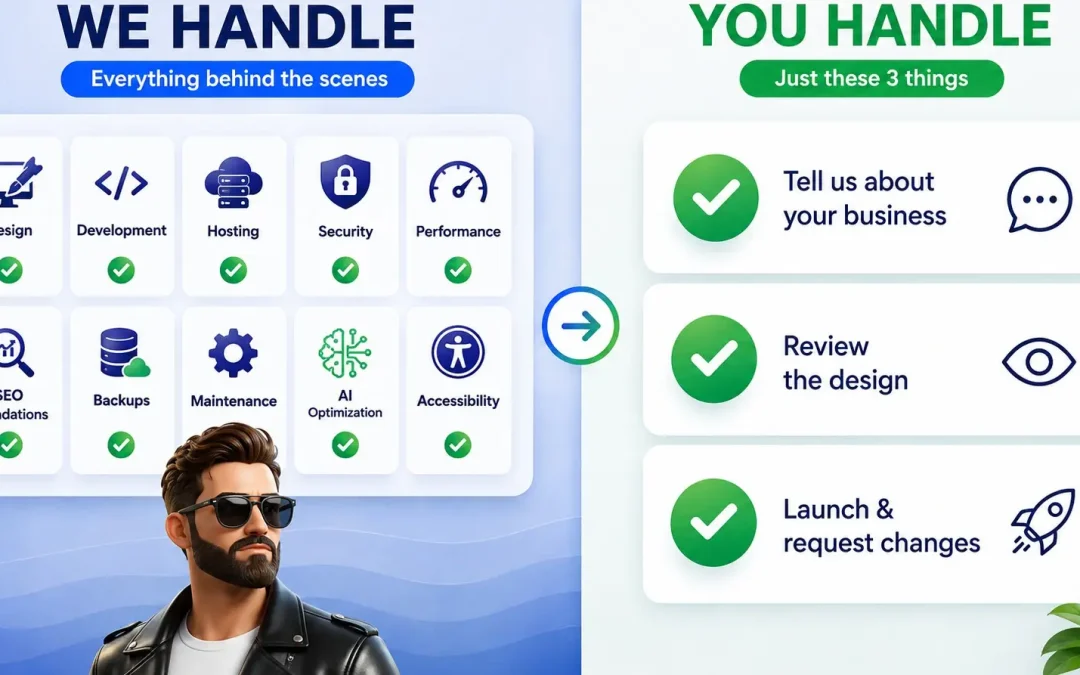
There’s no checklist, because a checklist would be shorter than the work. Hosting, plugins, security, the structure underneath the pages, all of it runs without anyone raising it with you.
Content gets written from scratch when there isn’t any. Edits after launch get handled the day they arrive. Files stay where they are rather than coming back to you as homework.
Below: what’s covered, what sits outside it, and why naming that line matters more than pretending it doesn’t exist.
Why There Isn’t a List
There isn’t one, and that’s the most honest answer available, because the scope isn’t a spreadsheet with line items and checkboxes. It’s a commitment that bends to meet whatever the situation puts in front of us. And situations don’t follow checklists. If we can fix whatever problem exists quickly and efficiently we will and if there’s a cost involved, we’ll always share that fee before doing any work. Our job is to make your life easier, period.
We had a carpet cleaning client who bought in completely on using real photos instead of stock images. Great instinct. Real photos of real work on a real site, that’s always the move. The problem was he didn’t have any. Nothing on his phone. Nothing saved anywhere. He was stuck, and he knew the site wouldn’t feel right without actual images of his completed jobs.
So we went to his Facebook page.
Sure enough, photos of finished work all over it. But Facebook compresses images to almost nothing. The dimensions were too small for full-width sections. A lot of companies would have handed the problem back to the client at that point. We need higher resolution images. Can you get us the originals? The client didn’t have originals. That’s why we were on Facebook in the first place.
Instead of handing it back, we pulled every usable image, redesigned those sections to work with smaller photos, and launched the site. Within a couple weeks he had new photos from recent jobs and we swapped them in. But the site was live and working from day one, because the scope adjusted to the reality instead of waiting for the reality to adjust to the scope.
That situation doesn’t appear on any intake checklist. Neither do the dozens of moments like it across hundreds of builds, moments where the path forward required something nobody planned for. That’s why the real list is not a real list. The scope of full service is a posture, not a document: whatever needs to happen for this site to work, we handle it.
Here’s what that looks like in categories.
The Back-End Work You Never See
Every site we build has an invisible layer underneath the design. The code structure. The schema markup. The heading hierarchy. The speed configuration. The way pages reference each other for search engines. What our founder calls “the code gobbledygoop.”
Most clients will never ask about this stuff. They’ll never see it. They wouldn’t know what they were looking at if they did. And that’s fine, because it’s not their department. It’s ours.
This is the foundation that determines whether the site performs in year three or starts showing cracks. A heading hierarchy that’s wrong on launch day doesn’t look wrong to anyone. A schema markup that’s incomplete doesn’t trigger an error message. The site loads. It displays the logo. It shows the phone number. But “functioning” and “right” are different things, and the gap between them compounds over time in ways that are invisible until they’re not.
All of this is included. Not as a premium tier. Not as an add-on you negotiate during the build. It’s the foundation of every site, handled entirely on our side, and the client’s experience of it is: nothing. That’s the point.
Ongoing Maintenance, and Who Watches It
After the build, the site needs continuous care. Plugin updates. Theme patches. Visual checks to catch things that break silently. SSL certificate renewals. Speed monitoring. Contact form testing. Security scans.
None of that is exciting. Nobody puts “we keep your website from dying” on their homepage. But it’s the difference between a site that compounds in value over time and one that slowly deteriorates while the owner assumes everything’s fine.
This is included in the monthly subscription. Not as a separate maintenance package. Not as an upsell after the build is done. It’s baked into how we operate because we’re the ones managing the site long-term. If something breaks, we’re the ones who live with it, so we maintain it before it gets to that point.
The client’s experience of this work is also: nothing. No maintenance reports. No alerts. No requests to approve plugin updates. The site just works, month after month, because someone is actively keeping it that way. That’s what hands-off website design is supposed to feel like, and the maintenance is a big part of why it does.
Content, Written From Scratch If Needed
Some clients come in with a folder. Brand guidelines, approved copy, a clear picture of what they want on every page. We build from that.
Some clients come in with almost nothing. No copy. No brochure. No “about me” paragraph. Just a business name and a vague color preference.
We’ve built great websites from both starting points. Content creation is part of the scope, and we don’t need a 47-page questionnaire to produce it.
What we need is a conversation. The onboarding call gives us the raw material, the language the owner uses, the services they emphasize, the kind of customer they’re trying to reach. We research the industry, the local market, the way people search for what this business offers. And then we write it.
Every single time, we’re upfront about what we wrote. The framing in the review meeting is always the same: we took some liberties. Some of it might be wrong for your specific situation. You tell us what to change and we change it. The client’s job in this arrangement is to review what we built and flag what we missed. That’s the extent of it.
That’s a different experience from being handed a blank content form and told to fill it out before the project moves forward.
What Happens After Launch
After launch, things change. Hours shift. A phone number updates. A new service gets added. A team member leaves. A photo needs swapping. A seasonal promotion goes up and comes down.
All of that is included. No ticket queue. No 48-hour SLA. No edit limits. You send the request, we handle it the same day.
That’s it. That’s the whole system.
The speed of it catches people off guard, mostly because they’ve experienced the alternative. They sent a request to their last company and it sat in a pipeline for a week. They followed up. Maybe got a response, maybe didn’t. Eventually they stopped asking or they switched.
The edit turnaround isn’t a feature we list on a pricing page. It’s a commitment built into how we operate, and it’s included whether the edit takes thirty seconds or thirty minutes.
Where Your Files Live
There’s a default in this industry that we refuse to participate in. A client sends a weird file, a .ai logo, a .tiff image, something the designer doesn’t immediately recognize, and the ticket gets bounced back. Please resend in JPEG or PNG format.
The client, who didn’t know the difference between those file types when they sent the first one, now has to figure it out. Find an old designer. Ask a friend. Google what a .ai file even is. They’ve been pulled into a task that has nothing to do with their business.
We don’t do that.
If a file needs converting, we convert it. There are free online tools that handle it in seconds. If it’s a complete hassle, you open the file in a viewer, screenshot it, crop it down, and that’s the logo. If it doesn’t need a transparent background, it’s fine. Twenty seconds. The client never hears about the obstacle that stood between the request and the result.
Individually, these moments don’t feel like much. But the accumulation of them is the entire client experience. They ask for a thing. It gets done. They never learn about the friction that happened in between. That’s what working with a company that handles it feels like, not one that handles it as long as everything is frictionless.
Third-Party Problems That Aren’t Ours
Sometimes the problem isn’t with the website. It’s with the hosting provider. The payment processor. The email platform. A third-party integration that updated something without warning and broke the connection.
When that happens, we don’t draw a line and say “not our responsibility.” We stay on it. We contact the third party. We keep the client updated. We push for resolution even when the timeline isn’t in our control.
There’s a version of this that resolves quickly, a hosting issue that takes two calls, an email configuration that needs a DNS record. Included.
And there’s a version that drags. Where the resolution lives in someone else’s hands and they can’t seem to get it together. In those moments, the scope isn’t a task list anymore. It’s the willingness to stay present, absorb the frustration, and keep pushing even when the fight is stalled.
Both versions are included. The client didn’t hire us to manage only the easy parts.
When the Request Isn’t the Real Question
Not everything a client asks for is the right move for their site. That’s a scope boundary most companies never address, but it comes up more than people think.
A client comes in wanting twenty pages. Our standard build is ten. The easy move at most companies would be simple math, charge more for more pages. And if twenty pages are legitimately needed, that’s a conversation we’ll have.
But more often than not, when we look at the page list, several of them can be combined. Two services that naturally nest under a single focus. A page that’s a slight variation of another one. Content that would create a worse user experience spread across five pages than it would consolidated into two.
Every page on a website needs a single focus, that’s not negotiable from a search perspective. But things that belong together don’t benefit from being split apart. Splitting them creates navigation bloat and dilutes the content.
So we put on what we call the consultative hat. We analyze the pages. We explain what we’d combine and why. We show the client what the navigation looks like either way. Then we make the decision together.
We’re not in the business of nickel-and-diming. If a site needs eleven pages instead of ten, that’s not an upcharge conversation. But if someone asks for twenty pages and twelve of them are redundant, we’re going to say so, because the right scope for the client isn’t always the scope they walked in requesting.
That consultation is included. Not as a paid strategy session. As the way we build.
Where Everything Ends
There are things we don’t do. Being clear about them matters as much as listing what’s included, because scope built on ambiguity eventually creates friction, and friction is the opposite of what this is supposed to be.
We don’t sign into your bank account. We don’t access your payment processor’s backend. We don’t manage your social media or run your ad campaigns as part of the website subscription. We don’t build custom software or web applications. If the site needs twenty legitimate pages, the scope expands, but that’s a conversation, not an assumption.
And there are situations where the resolution to a problem runs through a third party that we can’t control. We’ll fight for it. We’ll stay on it. But we can’t guarantee someone else’s timeline or competence.
The honest version of “we handle everything” is: we handle everything we can, we’re transparent about what we can’t, and we don’t pretend a boundary doesn’t exist because it’s inconvenient to name it.
That’s the whole of it. Not a brochure. Not a feature grid. A scope that flexes to meet the situation, and a company that tells you the truth about where it ends.
You already know if your current web company handles it or hands it back. If the answer is the second one, start with a conversation.
Frequently Asked Questions
What’s covered under full service web design?
The scope covers the full build, design, content writing, back-end structure, SEO foundation, and launch, plus ongoing maintenance, same-day edits, file handling, content updates, and third-party troubleshooting after launch. The monthly subscription covers all of it. There’s no separate maintenance tier, no edit limits, and no surcharge for the things most companies would hand back to you.
Is content writing included if I don’t have any copy?
Yes. Most clients provide some direction during the onboarding call, what they do, who they serve, what makes them different, and we write from there. If you have nothing at all, we research your industry and your local market and build it from scratch. You review what we wrote and tell us what to change. That’s the extent of your content obligation.
What happens when I need something outside the standard scope?
We talk about it. If a site legitimately needs more than the standard build covers, significantly more pages, a complex integration, something unusual, we’ll have an honest conversation about what that looks like. But we also analyze the request first, because a lot of what clients think requires extra turns out to be achievable within the existing scope or better handled by consolidating. That consultative approach is built into how we work, not billed as a separate session.
Do you handle things that aren’t technically part of the website?
Within reason, yes. File conversions, image optimization, email troubleshooting that affects the contact form, DNS issues that came with the domain transfer, if we can handle it and it keeps the client’s experience smooth, we handle it. Not everything falls inside the subscription, but the willingness to figure it out instead of bouncing it back to you is always there.
What counts as outside the scope?
Most companies build and hand off. Maintenance is a separate package. Edits go through a ticket system with response times measured in days. Content is the client’s responsibility to provide. Unusual files get returned. Here, all of that sits inside the ongoing relationship, and the scope is built to reflect that.