
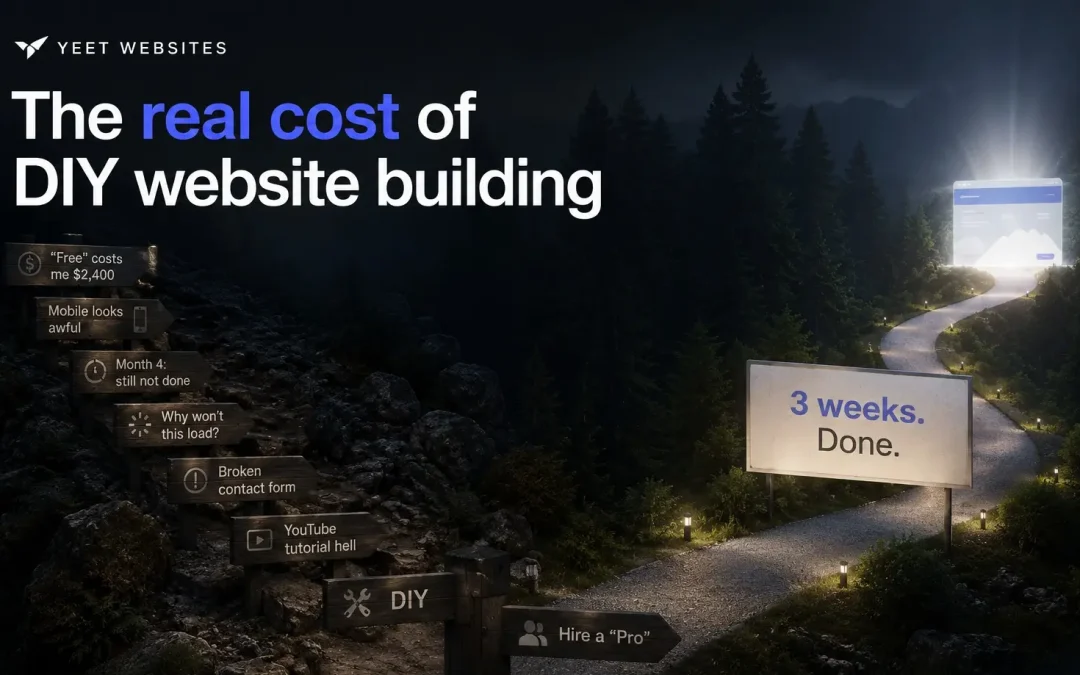
Post Summary: Where the Money Goes That Isn’t on the Bill
The platform fee is the smallest number in this decision. Four costs sit behind it and none of them appear on a statement.
Hours come first, and not the ones spent building. The ones spent building it a second time, which run into the low hundreds across a first year once troubleshooting is counted. Then there’s what search engines hold onto, because renamed pages and jumbled headings and images nobody described stay in the index long after you’ve forgotten making them. Third is the replacement those two make necessary, and almost nobody sets money aside for it. Fourth converts to nothing at all: evenings spent feeling out of your depth on the thing strangers judge you by.
Cost One: The Time to Build It Twice
The first cost is time. Not the time to build it, though that’s substantial, but the time to build it wrong and then rebuild it. Because here’s the thing about website platforms: they’re designed to feel simple. Drag this here. Drop that there. Change the color. And for about 45 minutes, it does feel simple. Then you start trying to make it work properly, mobile layout, page speed, navigation logic, contact forms that go somewhere, images that load without killing load time, and the simplicity disappears fast.
Most business owners who come to us after a DIY experiment underestimate how many hours they put in. They remember the launch day. They don’t remember the 40 hours before it, or the 10 hours a month after it troubleshooting things that broke, or the three weekends they lost trying to add a new service page.
Think about what you make per hour running your business. Not what you pay yourself, what your time is worth when it’s focused on revenue-generating work. Consultations. Jobs. Sales calls. Client relationships. Now multiply that number by a conservative estimate of the hours your website is pulling you away from those things.
That’s the real DIY website cost. And it doesn’t show up on any invoice.
Cost Two: What Google Remembers
Google has an extensive memory, and it keeps score in ways that are ruthlessly punishing. If you name a page wrong and have to redirect it later, that redirect lives in Google’s index for roughly 16 months, and from everything we know, that history counts against you. If your heading structure is wrong from day one, the site gets indexed with that wrong structure. If your images have no alt text, every image is invisible to search. These aren’t things you’ll notice immediately. They’re things you’ll notice 18 months from now when a competitor who built their site right is ranking above you and you can’t figure out why.
Cost Three: The Rebuild
The third cost is the one the first two lead to, and it’s the one people don’t budget for at all: paying to build the thing twice.
Almost every DIY site that comes to us needs rebuilding rather than adopting. That surprises people, because the site looks like it just needs tidying. What it usually needs is a foundation, and a foundation isn’t something that can be slid underneath a finished building.
The structure is the problem. Pages named without a plan, a heading order that was never a hierarchy, navigation assembled one addition at a time. Fixing those individually means touching every page anyway, and by then the rebuild would have been faster and cleaner.
What comes over is usually a mess: pages named wrong, redirects stacked on each other, heading structures built with no logic behind them, images never optimized, contact forms going nowhere. Cleaning that up is its own project before anything moves forward.
So the hours from the first build don’t roll forward. They’re spent. Whatever went into building it the first time bought a lesson rather than an asset, and the money for the real site still has to be found.
Cost Four: The One Nobody Puts a Number On
It’s 10:45 on a Tuesday night. The kids are in bed. The invoices are done. And you’re sitting in front of a laptop trying to figure out why the hero image on your Wix homepage looks perfect on your screen and like a pixelated disaster on your phone.
You’ve been at this for two hours. It was supposed to take twenty minutes.
You’ve watched three YouTube videos. You found a forum thread from 2019 that might be relevant. You’ve logged in and out of the dashboard four times. And somewhere around hour one, the thing you told yourself you were saving money on started feeling like it was costing you something you can’t get back.
This is what the real DIY website cost looks like. Not the $14 a month. The rest of it.
The $14 is real. Nobody’s lying about the $14. What they’re not telling you is that the $14 is the cheapest thing about this decision.
That’s the fourth cost, and it doesn’t appear on any invoice. We’ve been in this long enough that we’re still learning something new about how websites work, daily, sometimes several times a day. Something changes in Google’s algorithm. A plugin updates and breaks something. A new best practice emerges around page speed or schema or mobile layout.
We’re professionals and it still keeps us busy.
What that night costs isn’t just the two hours. It’s a confidence drain. Every hour you spend confused and frustrated by something outside your expertise is an hour spent feeling incompetent, even if you’re an expert at the thing your business is supposed to do.
Your website is your business card online. It’s the first thing a stranger sees before they decide whether to call you or keep scrolling. If it looks like it was built by someone who was figuring it out as they went, and most DIY sites do, even the ones that look decent, that first impression is costing you customers. Customers you’ll never know about because they never called.
One year of lost customers, even at modest numbers, can exceed an entire year’s cost of a professionally built and maintained site. The math on DIY only works if the site does. Most of the time, it doesn’t.
The Acupuncture Clinic That Switched
An acupuncture clinic came to us after running their own site for a long time. They’d built it themselves, maintained it themselves, and by most measures they were satisfied with it. They liked it. They’d put real time into it and it felt like theirs.
That’s the toughest DIY situation to break out of, not the one where the site clearly isn’t working, but the one where the owner has convinced themselves it’s fine. Because the site is fine. It just isn’t good. And fine and good look identical to someone who’s been staring at the same pages for two years.
The hesitancy was real. Business owners don’t throw away work they’ve done, especially when that work is tied up in their identity as someone who figured it out themselves. There’s pride in it. We respect that.
But once they moved over, the thing they kept saying was that the time they used to spend on the website just evaporated. Not transferred, evaporated. They weren’t spending those hours doing website work anymore. They were redirected back to running the business. Seeing patients. Building the practice. The website stopped being a thing they managed and became a thing that worked.
That’s the version of this story that doesn’t get told in Wix ads.
Why People Start This Way
We’re not trying to make you feel bad about the decision. Starting with DIY often makes complete sense, you’re early, the business hasn’t proven itself yet, you need to conserve cash. We get that. A DIY website is still better than no website, even if it’s done imperfectly. And when the time comes to move past it, affordable website design doesn’t have to mean starting from zero, it means getting the foundation right so the site works as hard as you do.
But there’s a difference between “good enough to start” and “good enough forever.” The mistake isn’t starting with DIY. The mistake is staying there past the point where it’s working against you.
The fear is straightforward: what if this business doesn’t make it? What if I spend real money on a real website and six months from now I’m folding? That’s a legitimate fear. Starting lean makes sense when you’re not sure yet.
The assumption underneath the fear is that professional web design is expensive. And for a lot of companies, it is. But that assumption gets carried forward even after it stops being true, even after the business has proven itself, even after the revenue is there, even after the cost-benefit math has flipped completely.
None of that is a reason to avoid DIY when you’re starting out. It is a reason to be honest with yourself about when the experiment has run its course.
Three Months In and Still Not Working
Three months is usually enough to know. Not enough to be certain, but enough to have a feeling you’re probably ignoring.
Here’s what honest looks like at the three-month mark: Is the site bringing in any leads? Not traffic, leads. People who found you through the site and called or filled out a form. If the answer is no, or close to no, that’s information. A website that doesn’t generate leads isn’t a website yet. It’s a placeholder.
Are you still spending significant time on it every week? If you’re three months in and the site is still pulling you away from billable work on a regular basis, that pattern is not going to fix itself. The site will keep needing attention. The question is whether that attention should be yours.
Be honest about what you’re capable of building. Not what Wix tells you you’re capable of, what you can deliver given everything else you’re managing. There’s no shame in the answer being “not this.” That’s not a failure. That’s resource allocation.
If the DIY route has run its course, the next step isn’t necessarily us. It might be. What’s worth avoiding is trading one set of problems for another: a template, a name on an invoice you never speak to, and a bill that doesn’t explain itself.
And if the real hesitation isn’t cost, it’s the anxiety of leaving a bad situation, that’s worth its own conversation. Switching web design companies feels more complicated than it is. The sunk cost of what you’ve already built tends to keep people in bad setups longer than they should be.
A boutique company that listens, builds to the vision you described, and tells you honestly when they’ve missed the mark, and then fixes it, is a different conversation entirely. That’s what the switch should look like.
Are you still doing this yourself because you want to, or because you haven’t stopped to ask whether you should?
Frequently Asked Questions
Is a DIY website ever good enough to keep long-term?
Sometimes, but “good enough” is doing a lot of work in that sentence. If your site is generating consistent leads, loading fast, looks professional on mobile, and you’re not losing significant time maintaining it, then the question is moot. If any of those things aren’t true, the real DIY website cost is quietly accumulating every month you stay on it.
Can you take over a DIY site, or do you always rebuild from scratch?
Usually a rebuild, for the reason above: the structure underneath is what needs replacing. Occasionally a site is sound enough to inherit and work forward from. We’ll tell you which situation you’re in before any work starts.
What’s the actual time investment for a DIY website build?
Most business owners we’ve talked to put in 80 to 200 hours over the first year, build time plus ongoing maintenance and troubleshooting. That number is always higher than they estimated going in. The issue isn’t just the hours; it’s that those hours come out of time that would otherwise be spent running the business.
How long does Google “remember” mistakes from a DIY site?
Redirect history and indexing errors can persist in Google’s systems for up to 16 months based on what we see in practice and what’s documented in the SEO literature. That doesn’t mean permanent damage, it means recovery takes longer than most people expect. The earlier you fix the foundation, the shorter that window.
What does Yeet Websites charge compared to what I’d spend on DIY?
Our subscription starts at $130/month after a one-time setup fee. Set that against your own hours at whatever they’re worth, and against the enquiries that never arrived. The cost calculator is a real starting point if you want to run it yourself.