
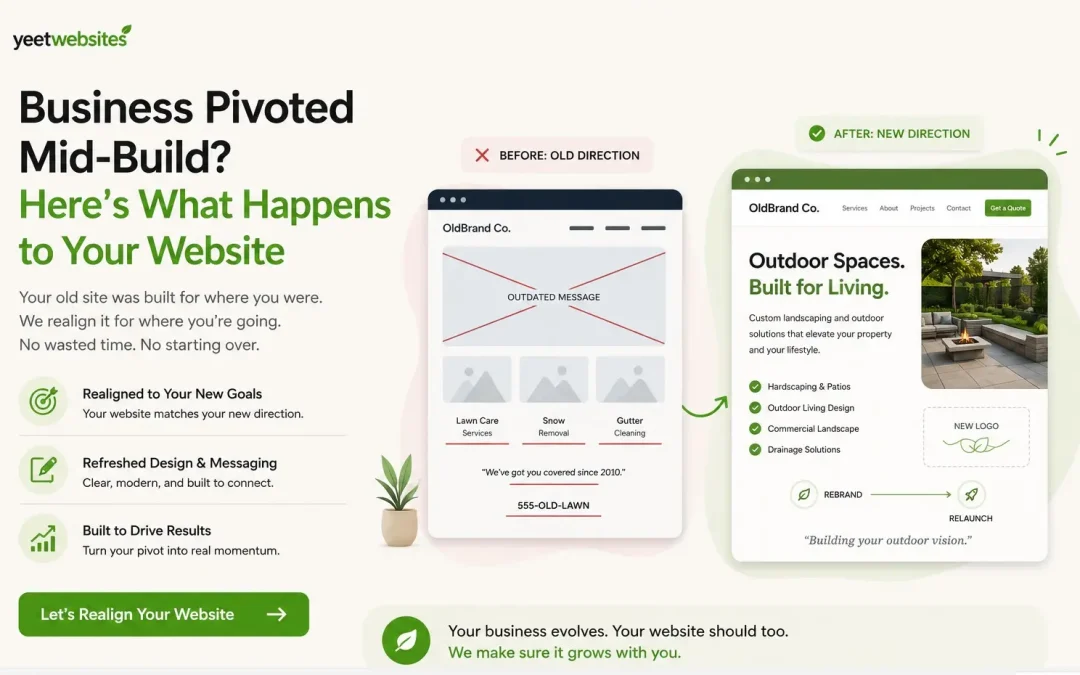
Post Summary: A New Business Model Needs a New Website, Not Edits
A consultant hired us to build a site around in-person work. Partway into the design she called with news: the in-person business was over and she was launching a course. Her first instinct was that a few edits could cover it.
They couldn’t. Whoever buys a course is at a desk late at night trying to solve a problem inside their own company. Whoever books a speaker is extending an invitation into their building. Two audiences, two moments, two sites.
Only the early design work was done, so restarting cost a couple hundred. She took it and we began again. The first version suited someone who walks into rooms. The second suited someone who works from a screen, and it came out well.
Rebuilding after a pivot isn’t a failure, it’s the accurate response. Editing headlines on a site made for a different business leaves you with neither one. New direction, new site.
She Pivoted Halfway Through the Build
She’d been a business consultant, in-person work, speaking engagements, the kind of career where your website is a business card. Something people glance at before they book you for a room.
The first phase of design was behind us. And then the call came. She wasn’t doing in-person anymore. She was selling a course. Totally different concept. Totally different everything. The question went from finishing a build to figuring out how to change a website after a business pivot that rewrote the entire playbook.
Why the Old Site Couldn’t Sell the New Product
The first thing she said was something like, we can just change this or that, right?
No.
I had to explain: this is a completely different website. And that’s such an important thing to understand. If you’re selling courses, that’s different than trying to convince someone you should come in and do a speaking engagement. It’s a different vibe. You’re selling a different product. A course is an online commodity, someone’s sitting at their desk at eleven o’clock at night worried about how to do business. A speaking engagement is someone inviting you into their location to talk. Those two things don’t live on the same site.
Once I broke it down like that, it made sense.
What Starting the Website Over Cost
Starting over costs money, and that’s worth saying plainly up front rather than discovering it halfway through. What a business owner needs to know is what it takes to change direction and start over, before the decision gets made.
But we’d just finished the first part of the design, so the cost wasn’t crazy. It was a couple hundred dollars. The client accepted it, and we moved forward.
I really loved the original design. But that design was built for a person who walked into rooms. The new business needed something built for a person who sat behind a screen. So we started over.
And it turned out great.
What a Pivot Means for the Site
The truth about a pivot is that it is starting completely over. That’s not a setback, that’s just what it is. What doesn’t work is patching the old version into something it was never built to be. When a business changes direction, the site changes direction. Full stop.
If your business just pivoted and the website still describes the old one, whether it’s a rebrand, a merger, or something nobody saw coming, the answer is the same. Work with what you’ve got. And if you need more, let us know.
Yeetish Question
Does a business pivot always mean starting the website from scratch?
If the business model changed, new audience, new offer, new direction, then yes, it’s a different website. You can’t take a site built to book speaking gigs and turn it into a course platform by swapping a few headlines. The vibe is different, the product is different, the person on the other end is different. That’s not a tweak. That’s a rebuild.